‘Side-Step Congestion’ / Bus Priority Systems / BRT
This page looks at ways to reduce / solve the "if I'm going to get caught in traffic, I might as well endure the delay sitting in my car" issue, looking at several types of bus priority technology which can help buses avoid traffic congestion and other sources of delay.
Many of the solutions seen here will also be constituent parts of what is known as Bus Rapid Transit (BRT), this being an enhanced urban transport system which uses rubber-tyred buses - and not steel wheeled trains & trams. BRT typically features traffic signal influencing, higher quality 'stops' which include proper shelters + real-time information, off-vehicle ticketing, dedicated lanes on roads which are shared with other traffic, (if road width allows) and private rights of way.
With trolleybuses BRT becomes TBRT - TrolleyBus Rapid Transit - and the resulting lack of tailpipe pollution makes this the §only way that BRT can be as clean and non-polluting as electric light rail (trams / streetcar).
§At the present time 'plug-in' battery technologies are only capable of powering buses for short distances / not all day, whilst hybrid buses are still motor buses - albeit of a design which is a little less polluting than other types of motor bus. So neither of these represent commercially viable solutions for busy bus services in densely populated urban areas.Navigating through this website is easier with the navigator frame which should be to the left of this window. If it is not there then click here to turn it on! Alternatively there is a system map at the foot of this page.
More information about this website & why it was created can be found by visiting this website's "front" pages (link opens in a new window)
 .
.
Many images are "clickable" - run the mouse over them and if a "hand" appears then click & a larger version will open in a new window!
Page Index.
- The Congestion Dilemma!
- BRT terminology.
- Traffic Signal Priorities.
- Bus Gates.
- Bus Lanes.
- Bus-only Roads.
- Kerb Guidance - The 'O-Bahn' (Condensed version).
- Magnetic Under-Road Wire Guidance.
- Magnetic Under-Road Beacon Guidance.
- Kerb Guidance - The 'O-Bahn' (Full version, with many pictures).
Direct link to another page within the theme...
The Congestion Dilemma!
 |
|
|
|||
Many of the solutions seen on this page assume that there is space for either bus lanes or bus-only roads. However sometimes neither of these are viable options - that is, not without tearing a swathe through buildings to either widen existing roads or build new roads, this being something which would be 'deeply unpopular' with local residents and traders. |
|||||
|
So what about roads such as this seen here? This road is located in a very busy town centre which is also a major traffic destination. It is used by about a dozen bus routes. In theory it might just about be possible to squeeze a bus lane in down the centre of the road, but with congestion extending in both directions so which direction of travel should benefit? Simply banning through traffic would require viable alternative routes, and whilst there is a 'sort of' parallel major road about 1/3rd of a mile (600m) away the widely spaced access points make it totally unsuitable for local traffic (journeys would take considerably longer), plus all routes to and from it are already considerably more seriously congested than this road! In reality closing this road to through traffic and expecting that traffic to divert to the near-ish parallel major road would result in motorists voting with their steering wheels and diverting to other roads - including another busy local road which is also a bus route and the many quiet residential roads which have not already been closed to through traffic. |

Congestion! Congestion! Congestion! The parked vehicle seen in the distance on the left* is not the cause of the congestion - rather it is the traffic signals which control the exit of a one-way system that sends heavy traffic through residential roads. (*easier to see in the two clickable larger versions 1
2  ) ) |
||||
Recent years have seen many changes to road layouts in the local area, with in many cases the addition of extra traffic signals. As the deep zoom version
(link here) BRT TerminologyThe term 'Bus Rapid Transit' (BRT) is an Americanism for a limited stop 'rapid transit' style bus service which has been designed to approach the service quality of 'urban transit' railroads. Because there will be fewer and more widely spaced bus stops and as much as possible the BRT service will benefit from congestion - free private rights of way (or upgraded existing infrastructure) so it will normally operate at higher average speeds than 'normal' urban bus services. Other countries use terms such as 'Busway'. The French also use bus à haut niveau de service' (BHNS) with the word 'BusWay' being a marketing brand name. In Britain the word 'busway' would be better understood as referring to the road the bus uses (typically a bus-only right of way) - and the name used by a bus company. For 'better' bus services the term 'Quality Bus Partnership' (QBP) is sometimes used, but more often this refers to a partnership between one or more bus companies and local government, where all parties in the QBP will make financial investments in improved vehicles and infrastructures (bus stop shelters, bus lanes, etc). In most cases a QBP will apply to existing short distance local urban buses which almost entirely operate on roads shared with other traffic. Even where there is some private bus-only rights of way few use anything more than ordinary buses. Because of the deregulated 'free for all' nature of bus operations here in Britain§ one of the hopes behind the QBP system is that it will be possible to legally prevent spoiler bus companies from going into 'head to head' competition along the transport corridors concerned. They do this by using cheap (often pre-used) buses, only operating at busy times, paying their staff 'below average' rates and charging passengers unrealistically low fares. This results in the fare base being split, and since bus companies must fund all investments from the farebox so this prevents otherwise worthwhile investments in bus transport. §Bus deregulation does not apply in London or Northern Ireland, although this does not mean that everything is 'all good' in these areas and 'all bad' elsewhere. Indeed, London is where one of the most embarrassing bus debacles in recent years occurred, when a showpiece BRT system which also enjoyed exceptionally enthusiastic support by some of the highest politicians in the land ended up failing to carry a single fare paying passenger (see below). |
|||||
Typical BRT features will include many of the following:-
|

A 'bus-only' road on the T Zen BHNS (BRT) service in Essonne, which is a French département to the south of Paris. Note the tram-style special traffic signals. Image & license: Poudou99 / Wikipedia encyclopædia. CC BY-SA 3.0 http://commons.wikimedia.org/wiki/File:TZEN-L1_IMG_0305.JPG |
||||
Many of these features can also apply to ordinary bus services, and with limited exceptions this page focusses more on bus transport per se than types of bus transport. Traffic Signal PriorityTraffic signals are a well-known cause of traffic congestion, delay and increased air pollution (from idling and accelerating vehicles) - although they are often a necessary evil at very busy road junctions. Often 'new build' and upgraded older light rail (tram, streetcar) systems will benefit from an ability to influence the signals to make them change in their favour, so that they either do not need to stop or the waiting time can be minimised. When buses are fitted with detection systems (such as radio tag transponders) it should then become possible for them to benefit similarly. Especially bus services on BRT routes. Likewise, just as light rail often uses dedicated and distinctive-looking traffic signals which can provide priority and reduce the likelihood of confusing other road users, so even 'normal' urban buses can benefit from the same too. Sometimes, these signals will be (virtually) identical to those used by the light rail, other times there will be different but still distinctive designs which are solely for the buses. There is no absolute pre-ordained ruling on the designs of the special bus signals, although it helps if there is consistency within each locality. Sometimes buses will follow normal traffic signals when on the mixed-use public highway, and special signals when in 'BRT mode'. |
|||||
 |
|
 |
|||
| A Schaffhausen, Switzerland, trolleybus turns left from a kerbside lane otherwise dedicated to traffic travelling 'ahead only' so that
it can bypass other traffic wanting to turn left. This movement is facilitated by special 'white dot' signals (see close-up right) which are used
extensively throughout Switzerland to give street based public transport (buses, trams, etc.,) priority at traffic signal junctions.
Not seen in either picture is an enforcement camera which photographs vehicles jumping the lights when they are red. As the camera captures an image of the front of vehicle it will be possible to recognise the driver. 
Clicking either the projector icon or this link will download a 16 second video clip named 'Schaffhausen-t-signals320.mpg' which shows the action being described. |
|||||
 |
|
 |
|||
| The simple expedient of a green lamp with the words "bus" or "taxi" which illuminate a few seconds before the main signals change from red to green gives the trolleybuses (and taxis) in the Austrian city of Salzburg the ability to move off slightly in advance of the general traffic. | |||||
 |
|
 |
|||
| Options can vary where buses and light rail use the same road. In this example from the French city of Strasbourg the trams use white tramway signals and the buses use normal red / yellow / green lenses which show the word 'bus'. | |
The former Welsh Swansea Metro BRT included some dedicated bus priority traffic signalling which comes in the form of a pictogram of a single-deck bus. |
|||
In the image below the signal head on the left is for buses which turn left, the signal head in the centre is for light rail services which travel 'straight ahead' and the signal head on the right is for buses which turn right. The city is Stuttgart, Germany. It will be easier to see the signals (including the illuminated triangle) in the clickable larger version. From the top working down the indications are...
|
|||||
|
 |
||||

Bus GatesSometimes also known as bus only links, bus gates are typically either short sections of road which have been designated for use by buses only or a physical barrier which prevents abuse of a section of bus-only traffic lane. The reasons for installing a bus gate can include:-
Enforcement of a bus gate can be by means of simple road painting and / or signage, perhaps in conjunction with bus-activated traffic signals, however because violation is common and very easy (even with CCTV surveillance to catch the offenders) so frequently bus gates will include some sort of physical obstruction designed to make it nigh-on impossible for unauthorised vehicles to pass through. A much favoured solution is the a rising bollard, as seen below. The approach of the bus should be automatically detected and the bollard lowers, rising again after the bus has passed. Sometimes unauthorised vehicles which try to pass through a bus gate will face damage, for instance trying to follow a bus past a rising bollard may see the bollard rising and striking the underside of the offending vehicle, and even partially lifting it off the ground. Of course road users who obey the rules do not face such issues - although sometimes new traffic management schemes which result in previously open roads being fitted with bus gates (and everyone else forced to follow an alternative routing that is inconvenient) so infuriate other road users who have been travelling that way for many decades that they will be very tempted to try and force their way past the bus gate. One location where this type of scenario applies is in the Hillsborough area of Sheffield, where a combined bus and tram gates is credited with significantly reducing delays to the public transport but local residents complain means that they can drive within sight of their homes and are then forced to follow a circuitous routing of up to a mile before they can actually access their streets. |
|||||
 |
|
 |
|||
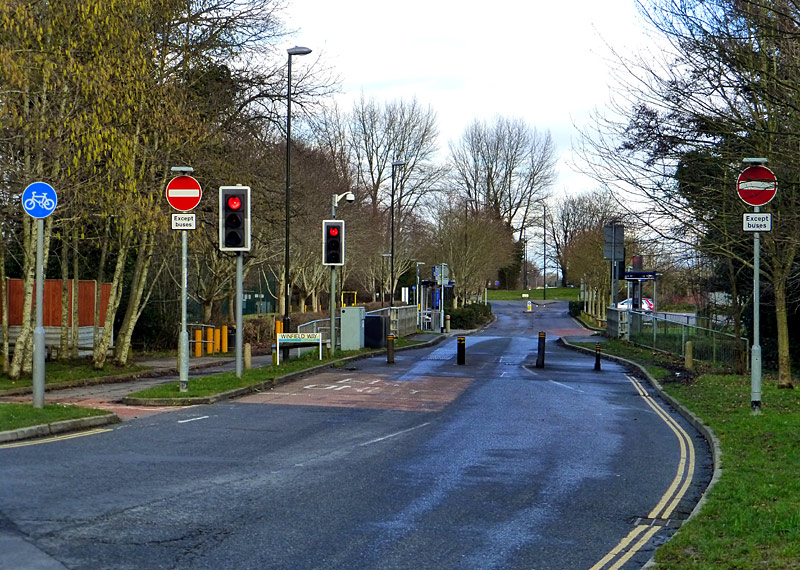
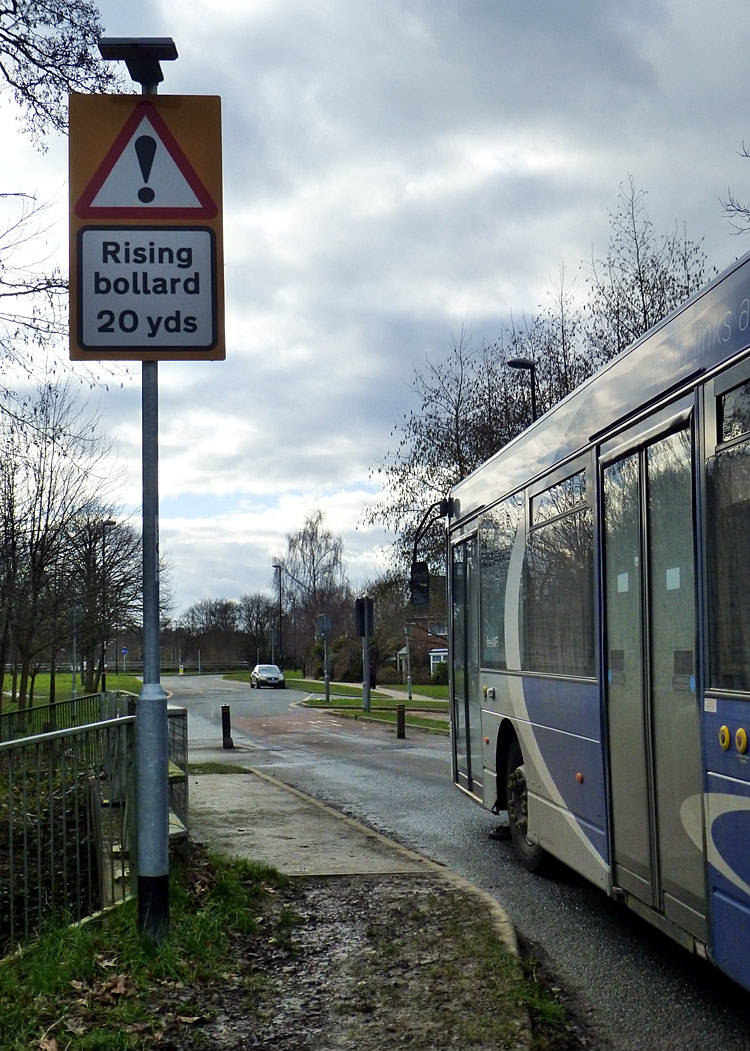
| A bus gate with a rising bollard on a busy residential road which is subject to a width restriction so as to prevent unsuitable large commercial vehicles from using
this road.
Left: A general overview. Buses will be too wide to pass through the 7' 0" (approximately. 2.13m) width restriction, but will be able to use the centre lane as the physical obstruction (rising bollard) lowers automatically on their approach. Note that this bus gate is bi-directional, as bus services operate in both directions. Right: A bus about to pass through the bus lane / dedicated section of bus-only road. The bollard has lowered and a green illuminated light on the post to the right of where the bollard had been advises the bus driver that they should proceed. Note the 'give way' road markings and (on the far side of the road) road sign with a message warning other traffic about buses merging from their right. |
|||||
 |
|
 |
|||
| A bus gate with a rising bollard designed to prevent other traffic from using a short bus-only section of road between a residential area and a busy roundabout. The bollard is seen in the raised position in the image on the left and the lowered position in the image on the right. | |||||

Image: Smiley.toerist / Wikipedia encyclopædia. CC BY-SA 3.0 http://commons.wikimedia.org/wiki/File:Chrystalis_Lyon_Nord_C2_Mont%C3%A9e.jpg. |
|

Image: Smiley.toerist / Wikipedia encyclopædia. CC BY-SA 3.0 http://commons.wikimedia.org/wiki/File:Chrystalis_Lyon_Nord.jpg. |
|||
A three-laned road in Lyon, France where the two outer lanes are used for single file traffic whilst the bi-directional middle lane is reserved for bus priority. Which
direction of travel uses the middle lane depends on peak traffic flows. A rising boom arm enforces this bus priority traffic restriction. As this road is served by trolleybuses the middle lane is wired for both directions of travel.
Another type of bus gate uses sliding gates which completely block a (bus-only) roadway. An example of the latter can be seen further down this page, in the section which looks at bus-only roads.
Bus LanesThe most well known form of bus priority is the bus lane, which is a traffic lane that for all or part of the day is subject to a Traffic Regulation Order which restricts it to buses only. In Britain the law says that any motor vehicle constructed or adapted to carry more than 8 passengers (plus the driver) can use a bus lane, unless the word 'local' is included with the bus 'pictogram' on the bus lane road signs, in which case only vehicles providing a local bus service can use it. 'With flow' bus lanes are for buses travelling in the same direction as the general traffic, 'contra-flow' bus lanes allow buses to travel in the opposite direction. |
|||||
 |
|
 |
|||
| 'With-flow' kerbside bus lanes as seen from the top deck of a bus. (Seen 'off-peak' - when delivery vehicles are allowed to stop). The black borders are because the image comes from a camera which takes panoramic photographs. | |
This bus lane in Regent Street London ends with traffic signals designed to hold back general traffic and make it easier for buses to reach the next traffic signals, which are only a very short distance beyond here. | |||
 |
|
 |
|||
Contra-flow bus lanes with and without railings between the bus lane and the other traffic, as seen in Piccadilly and the Kings Cross area, in London.
The railings are primarily to discourage pedestrians from crossing the road, as often they forget to look both ways and there have been accidents caused by pedestrians walking out in front of approaching buses. These bus lanes allow buses to side-step lengthy one-way systems which the general traffic has to follow. Also note that because of the urban air pollution the cyclist is wearing a face mask. The image below-right shows a kerbside bus lane in Turin, Italy, which is partially protected from abuse by means of the same type of low-height physical devices as is used to protect the street tramway from abuse. Whilst the bumps and flaps can be driven over their presence will be felt by the vehicle driver and especially with respect of the red flaps at the start of the bus lane theoretically could even damage a vehicle. |
|||||
 |
|
 |
|||
| Since the aim is to prevent buses from being delayed by traffic congestion - and NOT to raise revenue through entrapment of other road users - it is important that side roads include bus lane signage, as seen here.
Otherwise road users entering the main road are unlikely to know that there is a bus lane and end up being fined for entering it. |
|
A bus lane in Turin, Italy, with tram-style protection from abuse, as detailed above. | |||
|
Usually bus lanes are located along the inside (kerbside) lane of the road as this is convenient for passengers at kerbside bus stops. However these bus lanes are often blocked by parked vehicles forcing the buses to divert to the next lane - a process which frequently causes delays to buses and other road users alike. As a contrast because they cannot switch lanes trams usually use the road centre as this keeps the kerb free, for instance for vans delivering goods. There is no reason why bus lanes cannot be located down the middle of the road too although for safety reasons bus stops would then need to be equipped with island loading platforms as otherwise boarding & alighting the bus would require the passengers to walk out into the path of moving traffic (a potential safety hazard which sometimes happens on older tram systems, although new tram systems always ensure that a safer solution is found). The principle constraint to central bus lanes and road-centre bus stops with island loading platforms is that many roads are just not wide enough! Whilst it could be possible to widen the roads by demolishing buildings and / or narrowing the footpaths these options would probably result in a public outcry of opposition. |
|||||
 |
|
 |
|||
| Bus sharing part of a tram right of way in Krakow, Poland. Image courtesy of Jacek Makuch. |
|
Road-centre bus lane in Geneva. | |||
The example above - left from Krakow in Poland depicts a two-way tramway where one direction's tracks have been paved to enable buses share the right of way. The sharing of tram rights of way is a simple solution - adding value to the land (roadspace) invested for the trams without negatively impinging on the other road users. Of course this is only a viable proposition in cities which actually have tramway systems! The Geneva, Switzerland, example above - right shows a road where the bus lane is along the middle, because the kerb lane is sometimes used by a street market, although on other days it is available for on-street parking. This is a two-way road with the other direction's traffic flow only having the use of one lane - not seen in this image is a delivery van which to avoid blocking that lane had parked partially on the footpath. Since this photograph was taken the bus lane has been rebuilt as a shared bus and tram lane. Bus Lanes As Part Of BRT Systems |
|||||
 |
|
 |
|||
In Arnhem, Holland the "Trolley 2000" transport plan has seen the creation of much reserved lane transport corridors, giving buses the same degree
of priority and protection from traffic congestion as other cities give street running trams / light rail. Note the special (white / amber / red 'dot') traffic signals - a feature usually
only found on tram systems.
It is advantageous for Arnhem that it uses trolleybuses, which share the same clean air advantages as trams / light rail as this helps it maximise the environmental benefits of its investment in the BRT. Having seen how the creation of congestion-free transport corridors is such an essential element in the success of light rail, many cities globally have been looking at copying this as part of new BRT systems. In so far as installing busways should be cheaper than installing tramways / light railways (for instance: the roadway will not need digging up and rails installing) then this is quite understandable, and for many routes - where passenger flows will not be sufficient to support the steel wheeled transports - this can represent a cost effective option. However it is most unfortunate that by choosing to ignore another of the passenger attracting features of light rail the transport operators are quite literally choosing for their system to fail environmentally. Only with trolleybuses can buses achieve the same 'clean air' environsensible advantages as light rail, thereby maximising the benefits of the transport corridor. It cannot be reiterated enough that hybrid buses are NOT 'ZEVs' (zero emission vehicles) and that as with ordinary 'mechanical transmission' buses they still pollute their local environments - ie: the streets we use / the air we breathe. The only buses capable of being true 'ZEVs' are battery electric, roadway power and overhead wire trolleybuses. These - along with electric trams, streetcars & light rail - do not give off any tailpipe pollution at all! Of these only trolleybuses represent mature and proven viable technology. Plug-in battery electric technology has only been proven viable for small mini and micro buses - and even then these buses still need boost charging during the day. |
|||||
It is known that there are people who simply choose to avoid motorbuses, not just for environmental reasons but also because the travelling environment (noise, vibration, smells) is usually less than favourable. So simply painting a few lines on a road surface and calling it a bus lane is just not enough if transport operators are serious about maximising the user attractiveness of their system. It also helps when there are roads wide enough to create bus only lanes without creating urban gridlock - for many British cities this too is a challenge to be overcome. In Europe the creation of such transport rights of way are often coupled with other changes to road layouts to increase traffic capacity on alternative routes. |
|
 Also in Arnhem, rather than make the buses stop so that pedestrians can cross, this pedestrian crossing has a warning sign that flashes when a bus is approaching - so that the pedestrians can allow it to pass by unhindered.. |
|||
 |
|
 |
|||
| 'With-flow' kerbside bus & taxi lane protected by a raised kerb along a BRT trolleybus route in Rome, Italy. | |||||
The examples from Rome, Italy, shows a roadway where a raised kerb physically segregates one lane for use by buses (and taxis). Note that this is a triple-carriageway road with parking allowed on the outer two carriageways only - although often vehicles also park on the intermediate footpaths too. A variant of this used in other Italian cities (eg: Milan) sees the general traffic using (sometimes wider) outer carriageways and the public transport using the centre carriageway, which is two lanes wide. |
|
 Triple carriageway road in Milan where the general traffic uses the outer carriageways and the public transport use the centre carriageway. |
|||
When Choosing Bus Priority Solutions |
|||||
 |
|
 |
|||
For some bus lanes the theme is one of a general priority lane for use by commercial vehicles - with a specific aim of helping them
avoid traffic congestion as often their working day is 'time specific'. |
 |
||||
Bus Lane Operating Hours |
|||||
 |
|
 |
|||
| A bus lane which applies 24/7. | |
A bus lane which applies in the weekday morning and evening rush hours only. This image was captured at the weekend, when traffic was very light, and with buses able to 'wizz along' at normal road speeds running early (when compared to the timetable) is more of an issue. | |||
 |
Bus Lane Woes...This car wanted to turn left but was unable to do so because all the 'general traffic' lanes were filled with stationary traffic queueing to pass a busy traffic signal controlled junction.Rather than wait in the side road for space to become available the driver went as far as possible, in the process blocking the bus lane. Why would a vehicle driver travel as far as possible? Out of 'sheer desperation' because if he / she did not do this it is likely that they would end up spending ages waiting for someone to let them in. |
||||
Bus Lanes Are Not Much Use When The Bus Cannot Even Enter It! |
|||||
 |
This example comes from the Holborn area of London; the traffic jam is primarily
caused by traffic queueing to pass the next set of traffic signals (not seen here). The structure on the right is an entrance ramp to the former Kingsway Tram Subway which was used by trams to / from south London travelling via the Embankment and Westminster Bridge. The seven minute journey time (from here to the Westminster area) is something which the present-day bus passengers can only dream of. The concept of running buses underground is looked at in the next section. |
||||
|
The road junction in the photograph above has what is known as a "yellow box" where technically road users should not enter unless their exit is clear. The penalty for contravening this involves both a fine and penalty points adding to a driver's license. This applies to bus drivers too! In London (and other cities'?) transport planners have been so zealous in painting road junctions with yellow boxes and "ringfencing" the junction by extending the area of the box to cover a far larger area than is really appropriate, that sometimes the exit has become so far away from the entrance that it is not possible to see the exit! Then they (the traffic planners) have started to use roadside surveillance cameras to prosecute otherwise innocent road users who inadvertently find themselves forced to break the law. At least once a taxicab driver appealed against his prosecution, and won, because the judge too decided that it was virtually impossible to avoid breaking the law. The same Internet based forum from which the bus lane comments above were sourced also discussed yellow box junctions and driver entrapment, with one person sharing a situation where a bus operator told London's transport planners that unless one specific box junction was altered so that their drivers were able to see the exit then it (the bus company) would instruct its drivers that instead of using "commonsense" they must blindly follow the law and never enter the box junction unless their exit is clear. Since the drivers were unable to see the exit this would mean that they would remain stopped at the box junction's entrance. Of course this would have caused traffic chaos, but short of a uniformed police officer telling them otherwise it would be the only legal way to comply with the letter of law! |
|||||
Another bus driver told of an incident when a taxi driver performed a "u" turn at a traffic light junction with a yellow box, which resulted in the bus no longer being able to exit from the junction without fouling the yellow box. Despite it not being his fault this resulted in a fine, which the bus company (his employer) paid quickly to benefit from the 50% discount and then docked the funds from his pay. |

Although buses benefit from remote surveillance cameras (and bus mounted cameras) being used to monitor bus lane infringements they are still subject to road traffic laws and this can / does sometimes result in bus drivers (along with other road users) being prosecuted for other traffic infringements. |
||||
 |
|
 |
|||
An example of a yellow box which has been shortened - as described above. Seen at the weekend when traffic is light.
It would be enlightening to know the thought processes of the planners who made this yellow box so large in the first place. Did they really not understand the full ramifications of their actions? If so then it begs questions with respect of their competence and suitability for their employment. Bus-Only RoadsAn alternative option to bus lanes is for complete roadways to be dedicated to buses. It could be said that giving buses their own right of way puts them on par with many of the more modern light rail systems, where shared use of the public highway, whilst possible, is usually minimised. However unlike light rail the bus will still need a properly made up road surface. (This does not apply to 'kerb guided' buses, a technology which is looked at below). As with bus lanes, bus-only roads still need to be protected against abuse by unauthorised vehicles, although typically this will only be at the end points which are usually junctions with public roads, and not along the entire length. In some conurbations taxis and the emergency services are also allowed to use bus-only roads. |
|||||
 |
|
 |
|||
| In Milan much of the orbital trolleybus service which encircles the city uses triple carriageway roads where the central roadway is restricted to buses and
certain other vehicles, such as taxis, motor bikes and the emergency services. Theoretically by having these semi private rights of way the buses are able to operate in BRT mode,
although the frequent (and sometimes lengthy) delays at traffic signalled junctions often seem to negate the benefits gained from their freedom from traffic congestion. As the image on the right shows, there are locations where the public transport lanes are protected by CCTV (etc.,) equipment. Similar is also used to detect vehicles violating the city centre 'restricted traffic' zone. These are probably easier to see in the clickable larger image. |
|||||
 |
|
 |
|||
A very different implementation of bus-only road protection is the use of physical gates which block access to unauthorised vehicles - and sometimes even pedestrians!
Often these gates will be electronically operated by transponder equipped buses.
This example is the Landore Express Bus Route in Swansea, South Wales. Located just to the north of the railway station it is a fully-enclosed bus-only road and about a mile in length. On one side the busway runs alongside the railway, whilst on the other side there is a walkway / cycleway which is physically separated from the busway by a high fence. At both ends opening gates allow permitted buses to enter / leave. Several bus routes use this busway, including 'ordinary' buses on a 'Park + Ride' service (as seen here) and between 2009 and 2015 the f-t-r 'StreetCar' buses which were used on the 'Swansea Metro' BRT service. Bus-only roads are frequently major constituent parts of BRT systems, although by no means should it be seen as the 'only' constituent. With trolleybuses BRT becomes TBRT - Trolleybus Rapid Transit - and in this form the lack of tailpipe pollution makes the buses as non-polluting as electric light rail / trams / streetcars. In much of Europe and the USA BRT is generally seen as a solution for the less busy transport corridors which need improving but do not justify the higher investment needed for steel-rail based transports. Frequently these will complement the cities' other existing rail based transports although there are a few cities which have installed them instead of steel rail based solutions. Outside of Europe BRT systems have found favour in some of the less (financially) wealthy members of our global family of nations, where the required funds for investment in steel rail based transports are simply unavailable (especially South America) as well as Britain, Australia and New Zealand, where the decision to use buses has been either commercially or politically motivated - for both financial and dogmatic reasons. |
|||||
 |
|
 |
|||
| In Arnhem, Holland some of the reserved lane transport corridors created under the "Trolley 2000" transport plan are in fact dedicated 'public transport only' roadways - in the example above left both directions are bus / taxi only whilst in the example above right buses travelling in one direction share roadspace with other vehicles on local journeys only. | |||||
 |
|
 |
|||
| The 'TransMilenio' BRT in Bogatá, Colombia. This is located in the median of a dual carriageway and features twin bus lanes per direction because it was designed for both local 'all stations'
and express services. As with several other South American BRT systems passengers pay their fares at the entrance to the shelter, so that when the bus arrives they can rapidly board at all doors.
Image sourced from bus manufacturer's promotional material. |
|
Many South American BRT systems require bus drivers to stop accurately at if the doors are to be correctly lined up with the gaps in the barriers (or bus shelter doorways). This is
the North Station on the TBRT section of the MetrobusQ network in the Ecuadorean capital city of San Francisco de Quito (usually known as just Quito).
Image: Droman87 / Wikipedia encyclopædia. http://commons.wikimedia.org/wiki/File:Quito_02.jpg. |
|||

http://commons.wikimedia.org/wiki/File: Tvm_hayeauxmoines_vueaerienne_busversantony2.JPG |
|

http://commons.wikimedia.org/wiki/File: Tvm_prefecture94_vueaerienne_versAntony.JPG |
|||
The Trans-Val-de-Marne busway in Paris, France. The TVM forms a tangential route across southern Parisian suburbs, 80% of which is segregated from traffic.
The view on the left shows a section with twin single lanes whilst the view on the right shows a bi-directional twin laned busway.
Image & license (both images): Eole99 / Wikipedia encyclopædia. CC BY-SA 3.0 AustraliaSeveral cities in Australia feature busway systems, including Sydney, Adelaide, Brisbane and Perth - although in the latter some sections of former busway have been converted to heavy rail. By 2012 Brisbane plans to have a network of 5 busways, which will be in addition to an extensive suburban electric rail system. Several of these are already open. These include the South East Busway, which is 16.5km in length and includes 2km of elevated roadway, 1630m of tunnel and 10 bus stations. For much of its length it is located along one side of a six-lane motorway. Although single track in each direction there are overtaking lanes at the stations. This allows express buses to pass buses making stops. The 4.7km Inner North Busway (INB) opened in two stages (February 2004 and May 2008) and allows buses to travel north/south through the Brisbane central business district without encountering car traffic. Much of the route travels through tunnels below the city centre. There are five intermediate bus stations. As of August 2009 also open is the 1.5km Boggo Road busway, about a third of which is below ground. There are 5 bus stations. One of the bus stations is next to a railway station, but despite the bus platforms being numbered 5 & 6 to follow on from the railway platform numbering sequence, the bus station is known by a different name! |
|||||
 |
|
 |
|||
 |
The two images above show part of Brisbane's South East Busway. The lack of road markings in one of them is because the road had just been resurfaced, and the markings were yet to be painted.
The image left shows the 'cage' (as seen from inside a bus) next to RCH (Royal Childrens Hospital) Herston Station on the Inner Northern Busway. The purpose of this wire mesh 'cage' is to protect the buses from the balls of a nearby golf course. Images courtesy of Aussie Bhoy. Reproduced here with permission following their publication on a thread named Mixed Brisbane Transport Pictures at the www.skyscrapercity.com group of forums. |
||||
New ZealandNew Zealand's first dedicated bus-only road serves the northern suburbs of the city of Auckland. Located on the eastern side of State Highway 1 (SH1) / Northern Motorway, it comprises a 6.24 km two-way dedicated busway and then a further 2.5km section of southbound (towards Auckland) busway which has been designed for future conversion to two-way use. In addition there are several sections of bus lane on the motorway shoulders. The busway ends near the Auckland Harbour bridge - which at present the buses cross using the motorway's main carriageway. Future phases are expected to include building a dedicated busway bridge. On the other side of the bridge there are further on-street bus priority measures in Auckland city centre. Use of the busway is restricted to buses of 25+ seat capacity, emergency and maintenance vehicles. It has also been designed for possible use by car pools (vehicles with 3+ people) which 'may or may not' come to pass and with possible conversion to light rail - which again 'may or may not' happen, depending on whether this proves viable. There are five bus stations which were designed with public safety in mind and include security features such as glass walls, low planted greenery, night lighting and CCTV. Other features include shelters, cycle parking, 'kiss + ride' facilities and at the two northernmost bus stations, extensive car parking for park + ride passengers. The original intention was that the bus stations would be served by local 'feeder' bus services where passengers would change for an express service (called Northern Express) to Auckland city centre. However whilst this still the situation during quieter hours public disquiet at having to change buses on what had previously been through journeys has resulted in the restoration of some direct peak hour express buses linking local communities with Auckland city centre. The busway is credited as having reduced peak hour journey times from around an hour (by car) to around half an hour, with about 39% of passengers on the Northern Express bus service not having previously used public transport. In addition to the new bridge over Auckland Harbour future plans are for the busway to become the spine of an ambitious bus-based public transport system. Something which had not been anticipated is the commercial interest outside of just the transport industry. Several television advertisements have been filmed on the busway - although requests to allow filming of car commercials were denied, having been deemed as inappropriate for a public transport facility. There has also been interest from overseas film location scouts wanting to use the 'futuristic' stations as backdrops. |
|||||
 |
|
 |
|||
| Constellation Park & Ride station. This station has car parking and several feeder bus routes. This view shows the feeder bus platforms while the express platforms are almost visible through the glass building.
Image & license: Nankai / Wikipedia encyclopædia. Public Domain. http://commons.wikimedia.org/wiki/File:Aklbusway07.jpg. |
|
Sunnynook station, viewed looking south. The barrier in the centre is to discourage users from crossing the busway at the station. Sunnynook station has north and south express platforms only, although bus stops
on the adjacent street and bridge are nominally 'platforms' of the station.
Image & license: Nankai / Wikipedia encyclopædia. Public Domain. http://commons.wikimedia.org/wiki/File:Aklbusway16.jpg. |
|||
CanadaThe Canadian Capital of Ottawa features an extensive and successful BRT Transitway. This is based on grade separated bus-only roads that by means of overpasses, bridges, and trench highways are located mostly either above or below street level, so that they rarely intersect directly with the regular traffic. The exception is in the city centre, where delays are commonplace. Buses which use the Transitway benefit from an ability to travel long distances without stopping for a single traffic light. Most sections of the Transitway have a speed limit of 70-90km/h (45-55 mph) between stations and 50km/h (30 mph) in the station areas. However with nearly 200 diesel buses per hour per direction travelling on the Ottawa Transitway's city centre section it is operating well over capacity. This has caused numerous complaints from residents and businesses about traffic disruption, noise and air pollution from diesel engines. No solution is in sight because even though the system was designed for conversion to light rail, the street-based city centre portion is not suitable, due to the fact that it uses public roads and has just the one bus-only lane per direction. Furthermore, even if the busiest routes were converted to light rail there will still be many other bus routes which would remain as bus services and building an underground busway through Ottawa city centre has been deemed to be prohibitively expensive. USAFor many years Pittsburgh has been acknowledged as making the most extensive use of bus-only roads in the USA, although with ever increasing traffic congestion recent years have seen some other US cities have also started to build BRT systems too. In all Pittsburgh's system comprises three separate sections of busway. The 4.3mile South Busway is said to be the oldest operating busway in the USA. It is used by 16 bus routes which serve 9 bus stops. The West Busway is five miles in length, is served by 11 bus routes and features six stations. The Martin Luther King, Jr. East Busway was built in two stages and now totals 9.1 miles in length. It is used by 34 bus routes, of which 31 are express routes that circulate within many communities and then benefit from a non-stop, traffic-free commute into Pittsburgh city centre. There are nine bus stations plus one bus stop. A distinctive feature of the MLK Jr. East Busway is that much of it is located alongside a very busy heavy rail right of way where the train and bus are separate but share the same overall transport corridor. Pittsburgh's system also includes several tunnels, including former railway tunnels now used by buses and a tunnel where the buses share a right of way with light rail services. Whilst some of the other American BRT systems include sections of single carriageway bus-only road there are several systems where the buses use HOV (high occupancy vehicle) lanes on the normal highway which are restricted to vehicles with two (or for some locations three) or more than people in the vehicle. |
|||||
 |
|
 |
|||
| The Mount Washington Transit Tunnel which is shared between (driver steered) buses and the light rail. Image courtesy of Bruce S. Cridlebaugh - follow this link to visit the website for more information http://pghbridges.com/pittsburghW/0584-4475/mtwashingtonPAT_tun.htm |
|
For most of its route the MLK Busway is located in a transport corridor alongside a heavy railway right of way.
Image & license: TheZachMorrisExperience / Wikipedia encyclopædia. CC BY-SA 3.0 http://commons.wikimedia.org/wiki/File:MLKBuswayPittsburgh.jpg |
|||
|
Another of the USA's high-profile BRT services is the Metro Orange Line in Los Angeles, California. Named after the many citrus trees that once blanketed the San Fernando Valley, this is Metro's only bus service which has a 'colour' name, although it is also known as route No. 901. Because of its special status the Orange Line is also the only bus service to appear on the Metro Rail System Map which depicts the region's network of light and heavy rail (steel wheel) transports. The reason for the Orange Line's special status is that from the outset it was designed with many of the characteristics which usually feature on a (steel wheel) light rail system, such as a dedicated right-of-way, stations spread further apart than is usual for local bus services (typically one mile apart), platform ticket machines for faster boarding, park-and-ride facilities and other amenities. Part of the Orange Line's route was a conversion of a former railway, although as some of these images suggest, there is also some street running too. The Orange Line also has its detractors, especially from the pro-light rail lobbies, who point out that in less than a year of operation the "Orange Line" busway pavement (ie: 'road surface' in British English) has become seriously rutted, deteriorated, and uneven, producing rough, uncomfortable riding quality for passengers and more wear and tear on buses. They also point out that by way of contrast, railway tracks tend to retain durability and smooth riding qualities for much longer. |
|||||
 |
|
 |
|||
| Typical station architecture seen at North Hollywood Orange Line Station.
Image & license: Rcstampede / en.wikipedia CC BY-SA 3.0 http://commons.wikimedia.org/wiki/File:North_Hollywood_(LACMTA_station).jpg |
|
A Metro Liner bus (with bicycle rack) at North Hollywood Orange Line Station.
Image & license: Cian Ginty / Wikipedia encyclopædia. Public Domain if attributed. http://commons.wikimedia.org/wiki/File:LA_metro_liner_with_bicycle_rack.jpg |
|||
 |
|
 |
|||
| LACMTA Orange Line bus heading toward North Hollywood at the intersection of Burbank Boulevard and Fulton Ave.
Image & license: lensovet / Wikipedia encyclopædia. CC BY-NC-SA 3.0 http://commons.wikimedia.org/wiki/File:Burank-Fulton_intersection.jpg |
|
Inside one of the Metroliner buses.
Image & license: Rcstampede / en.wikipedia CC BY-SA 3.0 http://commons.wikimedia.org/wiki/File:Metroliner-interior.jpg |
|||
|
Further north along the west coast, another BRT system worthy of note is the Emerald Express (EmX). Serving Eugene-Springfield metropolitan area in Oregon, the first route (the Green Line) opened in early 2007 and in less than a year later ridership in the transport corridor had doubled. The initial Green Line route features ten stops along a four mile (approximately 6.4km) route, with an extension currently under construction. Only about 60% of the Green Line is on private right of way, the rest uses the public highway. |
|||||
 |
|
 |
|||
| Hilyard Station. The distinctive design of shelters certainly makes for a creative design statement, although it has to be wondered how effective they are at offering waiting passengers protection from inclement weather.
Image & license: functoruser / Flickr. CC BY-SA 2.0 http://www.flickr.com/photos/functoruser/348559777/ |
|
An off-road bus-only road located in the median on a dual carriageway ('divided highway' in US English). Rather than use the kerb guided system (seen further down this page) the system is fully 'human driver' steered.
Image & license: Adam850 / Wikipedia encyclopædia. Public Domain. http://commons.wikimedia.org/wiki/File:EugBRT.JPG |
|||
 |
|
 |
|||
| EmX includes some island bus stops which requires the buses to feature doors on both sides. | |||||
| Image & license: Cacophony / Wikipedia encyclopædia. CC BY-SA 2.5
http://commons.wikimedia.org/wiki/File:Eugene-EMX.jpg |
|
Image & license: clipdude / Wikipedia encyclopædia. CC BY-SA 3.0
http://commons.wikimedia.org/wiki/File:EmX_vehicle.jpg |
|||
Transantiago: A Disastrous Implementation Of A BRT SystemIt is important that new high profile transport systems are implemented with the primary aim of adding value to the lives of the people who will use the system. Whilst no doubt this was the intended aim it is unfortunate that severe teething problems with the implementation of the Transantiago system in Santiago, Chile, has seen the very opposite result, with many commuters finding that the ending of through buses between their residential areas and places of work has resulted in journey times doubling. The matter is highly contentious, but judging by comments from various media sources (including specialist bus transport media) it seems that the system was started prematurely, without construction of the BRT infrastructure (bus lanes / bus stops) having been completed and without there even being enough buses to carry the passengers who must now travel on 'feeder' buses from their homes to the metro or Transantiago BRT bus stations, where they need to change vehicles to complete their journeys. Apparently not only has the inconvenience resulted in significant public disturbances - with as many as 830 people arrested at one disturbance alone - but also because so many people have been constantly arriving late for work February and March 2007 saw the country's economy suffering lower than expected growth. As ever it seems that the people suffering the most are those living in working class areas, which suggests that the implementation of the new system was made without enough regard to the needs of many ordinary working people.- ie: the people upon whom the economic well-being of the entire nation depends. The following text is dated to 1st July 2007 and comes from the English language page of the "Wikipedia" encyclopædia. It is hoped that this disastrous situation will improve 'very soon', and that other cities will take note to avoid similar situations arising. http://en.wikipedia.org/wiki/Transantiago. Transantiago is the public transport system that serves Santiago, capital city of Chile. It was introduced on February 10, 2007, replacing the previous chaotic system run by thousands of independent bus operators. The system works by combining local bus lines, main bus lines and the Metro (subway) network. It includes an integrated fare system, which allows passengers to make bus-to-bus or bus-to-metro transfers for the price of one ticket, using a single contactless smartcard. Transantiago has also spawned Chile's largest class-action suit, as when a community leader discovered the new transit system did not run to his old place of employment - forcing him to change jobs - he united some 800 other commuters who had suffered similarly in an action claiming damages of US$38,000 each. In what is being seen as an intelligent and civilised way to protest (instead of just rioting), the legal action is not being done to become wealthy, rather it is about getting respect. The Chilean constitution assures the Chilean people of a right to be able to live in dignity and in a clean environment, and under Transantiago this is not happening. One of the new features of Transantiago was the introduction of higher capacity articulated buses as replacements for lower capacity regular buses, with one articulated replacing two regulars. In August 2010 the Ministry Of Transport admitted that this policy has not proven to be as successful as it had been hoped it would be and the 1600 articulateds already in service would be phased out 'within 3 years', this being only halfway through their planned 12 years in service. The reasons suggested for this include their higher than expected fuel consumption, the long dwell times at bus stops as passengers board and that Santiago's bus infrastructure is not suitable for such large vehicles which fill entire bus stops. In Santiago many bus stops are served by several bus routes so this sometimes results in buses having to queue to call at bus stops. Previously it was possible to get two regular, shorter buses in a bus stop, plus their lower passenger capacity meant that stop dwell times were lower, resulting in a faster overall service. Although the focus is primarily on the transports per se - and not BRT as a transport technology - the following two links lead to pages with more information about South American and European enhanced high-capacity bus systems. Curitiba in Brazil, New-era High-tech buses.. New Delhi: BRT ClosuresThe Indian city of New Delhi opened a BRT busway in 2008 but in 2013 was reported to be on the point of closing it and ceasing to investigate other planned BRT busways in the city. According to the Chief Minister the problems include a combination of poor planning, lack of foresight and sloppy lane regulations. So many buses were using the dedicated bus lanes that it was not unusual for a queue of them to
stretch as far as the eye could see. A photograph in the January / February 2014 bi-monthly magazine published by BusesWorldWide http://www.busesworldwide.org
Bus-only Roads In The UKAlthough Brazil is said to be the first country to have a reserved lane busway system in a large city, the town of Runcorn, Cheshire, can claim the invention of this method of transport. Runcorn was one of the post WW2 'new towns' which was built around an existing rural community and unusually for the UK the provision for a bus-only road network was included in the design blueprint. It is approximately 14 miles [22km] in length and is shaped like a 'figure-of-eight' so that it serves most of the town's residential & industrial areas, with the busway 'crossing' in the town centre, where the buses serve the Halton Lea Shopping Centre. To better integrate with the shopping city and avoid other road traffic there are two short (approximately ¼ mile [400 metres]) elevated sections of busway, these include bus stations that were designed and built as integral parts of the entire complex. The northern elevated busway serves eastbound buses and the southern elevated busway serves westbound buses. The busway is mostly one lane each way and apart from a section of a couple of miles to the west of the town is fully segregated from other traffic. The road widens at bus stops to permit overtaking. Housing and employment locations are distributed such that 90% of the working population is within a 1/3rd mile [500 metres] or five minute walk of the nearest bus stop, with the stops being about ¼ mile [400 metres] apart. Many people see buses as having a 'down at heel' image, being solely for those people whose transport options will not extend to anything else. The Runcorn busway has not helped in countering this perception, as it has been subject to extreme vandalism (especially at bus stops) and general neglect. This helps explain why many promoters of other British BRT systems are so keen on being proactive in trying to create and maintain high quality transport operations. As they know, whilst very desirable, congestion-free private rights of way are not the whole story. |
|||||
 |
|
 |
|||
| Most of the busway is on private roads (with grassy verges / no footpaths) from which all except local buses are prohibited. Despite the sign also prohibiting pedestrians from this road some people were seen walking
along here (not photographed).
At the bus stops the road widens to allow buses which are not calling to pass stationary buses. |
|||||
 |
|
 |
|||
Included in the busway's distinctive features are the two elevated sections at the town centre so that the buses can better serve the Halton Lea Shopping Centre / Shopping City whilst
by-passing the possible traffic congestion on the public highway below. To facilitate this the elevated roadways include a bus stop with direct access to the shopping complex. However the use of diesel buses (instead of electric
buses, such as trolleybuses) means that for ventilation reasons the bus stopping areas have to be 'outside', with minimal weather protection. As a contrast the nearby multi-storey car parks are (mostly) covered, although the
sides remain open to provide ventilation.
These views were taken at around 10.30am on a Bank Holiday Monday, when traffic was very light. The North Kent (Thameside) FastrackCommencing services on Sunday 26th March 2006 'Fastrack' is a BRT system which is based on the creation of brand new bus-only roads, although in places it also uses the ordinary public highway (depending on where - with and without bus lanes). Ultimately planned to feature four routes, 'Fastrack' links several towns and other major traffic destinations just south of the River Thames in North Kent, this being an area which the national government would like to see benefit from greater development as a way of reducing the pressure for residential building in London. What happens to areas alongside the River Thames when global climate changes results in sea levels rising is a different issue. The ethos behind Fastrack is to provide a transport of a quality that is midway between the train and the bus (ie: 'better' or 'higher' than a normal bus service - more like a tramway) so there is a strict ban on any other bus services from using the newly constructed dedicated bus-only roads. This ban even extends to London's famous red buses which serve the nearby Bluewater shopping centre. One reason for the ban might be because under the British system of bus deregulation this is the only way that the system's backers can control the quality of the vehicles being provided. (The London buses can be banned because Dartford is in Kent, which is outside of the protected 'London' bus area). In its initial stages Fastrack uses normal single deck buses which were bought by Kent County Council with funding from the Office of the Deputy Prime Minister's Sustainable Communities Plan. It is anticipated that as traffic increases so higher capacity (and possibly distinctively styled) articulated buses will become financially viable. |
|||||
 |
|
 |
|||
| Primarily serving the towns of Dartford and Gravesend as well intermediate communities plus the Bluewater shopping centre and the Channel Tunnel Rail Line station at Ebbsfleet, the North Kent (Thameside) 'Fastrack' bus service is an outer suburban / regional system which includes many high quality BRT features - but unlike a comparable BRT system in West Sussex eschews kerb guidance for its private bus-only dedicated right of ways (see below). | |||||
 |
|
 |
|||
| Calling at a bus stop on one of the sections of private bus-only road. | |
The entrance to a section of private bus-only roadway which features signs that quite clearly specify this bus-only road as being restricted to Fastrack buses only. Seen from the top deck of a red London bus. | |||
 |
|
 |
|||
| Waiting for a green traffic signal at the entry / exit point just outside Dartford town centre. The inset shows how the bus lane sign includes the word 'local', thereby prohibiting longer distance bus and coach services from using this section of road. |
|
One side effect of prohibiting other buses is that the London (red) bus route number 96 which travels non-stop between Dartford and the Bluewater shopping centre must do so on the sometimes congested public highway - note the same traffic direction sign as in the view on the left. | |||
 |
|
 |
|||
To help minimise delays and speed the service Fastrack includes some 'bus gates' where traffic signals are used to regulate the flow of traffic with authorised
buses benefiting from a dedicated lane and traffic signals which are triggered by transponders.
However, as can be surmised from the image on the right, even transponder-equipped buses must stop and wait for the lights to change, with the delay being something that the bus drivers find to be a nuisance, so (when possible) they will seek alternative and faster options. Which explains why this bus is by-passing its dedicated transponder operated traffic signals and using the 'other traffic' section of the road instead.
Elsewhere In The UKA 'North Thames' counterpart of Fastrack is proposed for the Thameside regions in South Essex. Provisionally known as SERT (SouthEast / South Essex Rapid Transit) it is led by Southend-on-Sea Borough Council, Essex County Council and Thurrock Council on behalf of Thames Gateway South Essex partnership, which is masterminding the regeneration strategy for Thames Gateway South Essex. With global climate changes and the probability of sea levels rising in mind the wisdom of encouraging people to invest / live in a coastal area which might soon be flooded beggars belief. OK, this is not (yet) a transport related issue. |
|||||
 |
|
 |
|||
Originally constructed to act as part of a high profile government-sponsored 'showpiece' BRT system where the buses used an innovative self-steering technology based on the premise
of being guided (steered) by twin cables buried under the road surface, London's former Millennium Dome Busway now operates as an ordinary bus-only road. Because of the frequent long delays spent sitting at red (stop)
traffic signals at each end - and (often) along the busway too - for most journeys the passenger experience of this busway is one of Bus Tedium Transport rather than Bus Rapid Transport.
The innovative under - road guidance system is explored further down this page. Between 2009 and 2015 Swansea, South Wales had a 10 vehicle fleet of articulated StreetCar buses which were used on a high profile BRT system. Known as Swansea Metro (Metro Abertawe in the Welsh language) its route included a mix of private right of way and shared use of the public highway, including some bus lanes, High Occupancy Vehicle (HOV) lanes, the bus-only Landore Express Bus Route plus, where required, other bus priority measures. To avoid too much duplication the StreetCar buses are looked at in greater detail on the Hi-tech New-era Hi-tech buses page. |
|||||
 |
|
 |
|||
The Swansea Metro is a former British BRT system which used dedicated bus-only roads in the city centre and on the Landore Express Bus Route to the north of the city. Some of
these facilities were also used by other bus services, such as seen above right where a bus is seen calling at one of the new 'high quality' bus stops which was installed as part of the BRT scheme.
Opening in April 2012 the South East Hampshire Bus Rapid Transit scheme includes a 2.8 mile [4.5km] unguided busway between Gosport and Fareham, Hampshire. Constructed by Hampshire County Council, the busway uses the route of the former Gosport to Fareham railway which was scheduled to be included in a new tramline serving the area that was blocked by hostile government funding criteria. Funding for this £20m BRT scheme was approved in July 2009. The driver steered busway features 14 new bus stops (7 each way) which include real-time information displays and 24/7 CCTV surveillance. Some bus stops also have secure cycle parking facilities. The primary purpose of the busway is to act as the core of a larger BRT scheme which includes the refurbishment of 143 bus shelters and various bus lanes and bus priority measures. The relatively short section of bus-only roadway serves as a congestion-free alternative to the most heavily congested sections of the A32 roadway between Gosport and Fareham. Apparently, with its 40mph [65km/h] speed limit the entire busway can be traversed in under 10 minutes. Marketed as Eclipse Bus Rapid Transit several existing bus routes have been rebranded and upgraded for the busway. Routes 86 and 82 have become Eclipse routes E1 and E2, and these two routes operate every 15 minutes Monday - Saturday and at 30 minute intervals in the evenings and on Sundays. In addition, the busway is also used by a few other bus routes, especially in the Monday - Friday peak hours and by a service which uses just part of the busway on an hourly frequency. |
|||||
 |
|
 |
|||
| Eclipse BRT as seen at the Gregson Avenue bus stop. The image on the right explains why I did not walk along the bus road and photograph buses as they passed by. |
|||||
 |
|
 |
|||
| Eclipse BRT as seen at the Wych Lane bus stop where there is a traffic signalled junction with a public road. The level-crossing style booms are lowered at night, when the busway is closed. Some of the signage seems to be in night mode. It is possible that the buses were breaking the law when passing the signs showing a no-entry symbol; a pragmatic point-of-view suggests that an enforced diversion along other roads would represent a far worse outcome. | |||||
 |
|
 |
|||
Pedal cyclists are permitted to use the Eclipse BRT busway, but not motor cyclists. Unlike the Kesgrave / Cambridgeshire / Luton-Dunstable guided busways the Eclipse BRT busway does not cater for pedestrians,
which probably means that the jogger (not shown here) should not have been using this roadway.
Eclipse BRT uses 14 brand new purple and gold liveried high specification Wright Eclipse 2 bodied Volvo B7RLE buses which cost First (Hampshire & Dorset) £2.3million. They are 12 metres [40ft] long, 2.55 metres [about 8ft 4in] wide and use Euro V diesel engines. Internally they feature individual high-back leather seats, wood effect flooring, under seat lighting, internal CCTV surveillance cameras, infotainment screens and free wi-fi. According to the information by the passenger doorway Eclipse BRT buses are certified to carry 39 seated and 59 standing passengers, or 42 seated and 56 standing passengers or 36 seated and 61 standing passengers, plus passenger in a wheelchair. |
|||||
 |
|
 |
|||
| Inside an Eclipse BRT bus showing the high quality leather seating, eclipse branded headrests, wood effect flooring, and more.
The under-seat lighting was seen when the bus was caught at red traffic signals and had stopped under a railway bridge. |
|||||
 |
|
 |
|||
One unusual feature is that the busway has been designated as a protected street under the provisions of the New Road and Street Works Act. |
|||||
This means that any utility company which wants to dig up part of the busway to install apparatus (cables, pipes etc) must first apply for and be given permission by the County Council, in its role as Street Authority. The Additional information can be found at these links, which open in new windows |

The rules for using the busway and its services. The clickable larger image may be easier to read. |
||||
Kerb Guidance - The 'O-Bahn'This is a very much condensed version; more information and many more images - plus some maps - can be found on this page Kerb guidance is an off road technology which involves the creating of private rights of way (for buses) using a special trackway physically removed from the public highway. The first public kerb guided busway (KGB) opened in Essen, Germany in 1980, where the KGB system is usually referred to as "O-Bahn" although the terms "Bahnbus" and "Spurbus" are also used. The KGB trackway is similar - in theme - to conventional railway tracks except that instead of being designed for flanged steel wheeled trains / trams / streetcars it is designed for rubber tyred road vehicles. |
|||||
 |
|
 |
|||
| A kerb-guided duo-bus calling at a stop located in the median of an urban motorway. | |
A kerb-guided duo-bus calling at a stop located in the median of a dual carriageway elsewhere in the city. | |||
Kerb guidance uses ordinary buses (motorbus, trolleybus, etc,.) fitted with two horizontal guide-wheels (one per side, mounted immediately in front of the front road wheels) which steer the vehicle via guide-arms attached to the steering knuckle. The buses' road-wheels use the bottom leg of the precast panels and the guide-wheels run along the 18cm (approx 6") high upstand edge Sometimes additional touch-wheels are fitted next to the vehicles' rear wheels, (plus, on articulated buses, centre wheels) - these are not in continuous contact with the guideway but are needed for curves. |

The buses' road-wheels use the road surface, and the guide-wheels run along the inside face of a raised kerb (as seen on a British guided bus). |
||||
|
Whilst on the track the driver retains full control of the vehicle except that (s)he no longer needs to use the steering wheel! Away from the track the bus uses the normal road, just like any other rubber tyred road vehicle. The reasoning for mechanically guiding buses is that the resulting dedicated busway uses less space (land width) so can be much narrower than a driver steered busway. To allow for driver-steered buses to "wander" sideways slightly and still pass safely when travelling at even a moderate speed an ordinary two lane road needs to be at least 7.5 - 8 metres in width. However for guided buses the lanes only need to be a little wider than the buses, so for standard width buses of 2.5m (or 2.55m) the total width required for a two-way busway will be only 6m. The resulting saved space can make a significant difference when trying to shoehorn a dedicated bus lane in to a narrow strip of land. |
|||||
 |
|
 |
|||
| Waiting for the signals to change. The wait can often seem interminable and as a result if there are two buses here they often go through in convoy. |
|
A kerb guided duo-bus in electric mode, on a city centre section of trackway that was also used by trams. In 1991 this was replaced by an extension of the tram tunnel system. | |||
|
Essen's O-Bahn system was part of an experiment in bus transport started in the late 1970's whereby the (West) German Government Federal Ministry of Research and Technology funded a developmental project to perfect two recent German designed innovations in bus transport - the 'self-steering' kerb guided bus and the twin system 'duo-bus'* - by means of a phased programme of testing and evaluation over two (later became three) quiet suburban private rights of way which, if successful, could eventually be linked up via the city centre to provide a 'dual-mode-bus' demonstration system. (*For more information on duo-buses see the electric buses page; scroll down about halfway.) The rational behind the experiment was that over recent decades Essen, like many other (West) German cities, had followed a policy of upgrading metre gauge street tramways into standard gauge light railways and in congested city centres relocating both modes into underground tunnel systems. Its buses however remained on the surface, and as might be expected at times of peak traffic flow the delays often caused considerable disruption to services. Having built expensive infrastructure for the steel wheeled transports it was felt desirable to try to maximise the benefits of that expenditure by extending the buses through the tunnels too. |
|||||
 |
|
 |
|||
| The first tunnel section of tunnel operation saw buses calling at Porscheplatz station where they shared the centre two tracks with the trams. (Since this photograph was taken Porscheplatz station was renamed Rathaus Essen) |
|
The extension to the tunnelway saw kerb guided duo-buses calling at two more underground stations, where they used their off-side doors. | |||
|
The films below are fairly short so are also suitable for people with slower web connections.
Underground busway services have now ceased, this is because after just a few years the experimental wooden trackage became life-expired and with the ending of the developmental programme the funds were no longer available to replace it. In 2009 the original experimental section of kerb guided busway also closed, with its concrete track now having been removed and the route either landscaped or converted to a cycleway (different outcomes according to location). In 2016 the section of kerb guided busway in the Wittenberg forest where joint operations with trams were trialed also closed, with most of the route being landscaped - except for 300 metres leading up to traffic signals where a driver-steered bus lane was installed. The only remaining section of kerb guided busway in Essen is the route to the suburb of Kray which is in the median of a motorway. Future plans were for this to be converted back to a tramway, but financial pressures have seen this plan being delayed and possibly even shelved. If this conversion back to trams is shelved the route is to receive maintenance as required to extend its life for an estimated another 30 years. However this then poses a dilemma because German law says that by 2022 public transport must be accessible - and the kerb guided bus stops here can only be reached by steps. Apparantly there is insufficient space for lifts, although there would be sufficient space if the route was rebuilt as a tramway. Rebuilding as a normal driver-steered busway has also been investigated, but there are places where the available space is just not wide enough. In September 2001 the special duo-buses were withdrawn from service, having spent most of their lives operating as motor buses they were now deemed to be 'life expired'. They were replaced with low floor motorbuses. There are several photo-albums on the transport operator's Facebook page which may be of related interest.
Kerb guidance offers a transport operator a system that - without compromising the limited available roadspace - can help its buses avoid traffic congestion and therefore provide a more reliable service to their passengers. The possibility of tunnel operation shared with light rail services makes for added cost effectiveness because where vast amounts of money have been spent on putting rail systems underground it would now be possible to further increase the benefits of that expenditure by allowing the buses to join them. In the event, as yet no other city sees such shared tunnel operation, indeed the very existence of subterranean bus services is still very unusual - perhaps the oldest example being the short tunnel and station at Harvard in the Greater Boston area, USA. Also in Boston, the "Silver Line" BRT route includes some sections of bus subway. Apart from Boston there are only a handful of examples; perhaps the most significant of which is in Seattle, USA (see below). Two of the others are in Japan. These form part of the Tateyama - Kurobe Alpine Routes and see trolleybuses and battery buses using single - track tunnels where services often run in 'flights' with several vehicles travelling together in groups with one of the lines being controlled (signalled) using railway style tokens and the other on the basis of buses starting when the signal is clear and the number of vehicles being counted as they depart. However, as these services are tourist-orientated and not part of a 'serious' urban transport solution their status is somewhat different. The Seattle bus subway opened in September 1990. 1⅓rd mile (2.1km) in length it originally featured 5 stations which were open on Mondays - Saturdays only. Services were originally provided by a fleet of Italian duo-buses operating as trolleybuses in the tunnel and diesel buses elsewhere, with some routes providing a direct link to the city's airport. In those days Seattle had a city centre 'free travel' zone (known locally as a Ride Free Area) and during the hours when free travel was permitted (6am to 7pm [06:00 to 19:00]) passengers did not need to pay a fare to travel through the bus subway. Free travel ended in 2012. In its first year of operations 20 bus routes served the bus subway, carrying 28,000 daily passengers on 688 scheduled bus journeys. The number of buses using 3rd Avenue at peak hours went down from 190 to 86. At the time of construction rail tracks were also installed for a future light rail service. Unfortunately this commendable forward thinking was later found to have been of no value because penny-pinching to save US$1.5 million saw the rails being installed without the required electrical insulation, leaving them unsuitable for their intended purpose. In addition, it was subsequently decided that part of the light rail line would follow a different alignment than the existing tunnels. The bus subway was closed for building works for two years, closing on 24th September 2005 with 21 bus routes and 140 buses per hour relocating to surface streets. To help cope with the influx of buses, during peak hours 3rd Avenue was converted to a 'transit-priority corridor'. The Italian duo-buses were withdrawn from subway servces in advance of the closure, and (amazingly) replaced with diesel powered hybrid buses. In April 2005 local users were reporting on some Internet discussion groups that the tunnels had become somewhat smelly from (what thinking people know to be) the carcinogenic diesel engine exhaust fumes. This was because the buses used the parallel type of hybrid diesel-electric transmission system where battery power is only used for acceleration from rest (ie: when departing from bus stops or pulling away from traffic signals). Therefore, the fossil fuel traction package was required to be active when underground, although it operated in a special low power 'hush' mode. Apparently the choice of fossil fuel powered buses was influenced by the transport operators' belief that it is not possible (or not safe) to mix overhead wire powered light rail and electric trolleybuses / duo-buses in an underground tunnel system - even though Essen proved otherwise!
The bus subway reopened exactly two years later, on 24th September 2007. It was renamed the Downtown Seattle Transit Tunnel (DSTT) although many people call it the Metro Bus Tunnel. (Metro is the name of the local transport operator.) The works during the closure included lowering the tunnel floor (road surface) for the light rail and this led to concerns that the bus wing mirrors - which were now at head height - may strike people waiting on the platform. In an effort to prevent this the mirrors were equipped with flashing lights and the speed of the buses within the stations was lowered from 15mph to 10mph (24km/h to 16km/h). The Central Link light rail system opened on 18th July 2009 and for a number of years shared the tunnel with the buses. Because bus and light rail ticketing were not fully harmonised and the light rail charged fares at all times a strange situation arose whereby at times when the Ride Free Area was operational bus passengers were able to travel through the subway for free but light rail passengers had to pay. Apparently including the light rail in the free fare zone would have resulted in light rail fares being 25 cents higher. One the stations (Convention Place) was permamently closed in July 2018. This was because the station had been sold to the It was always intended that eventually light rail would completely replace the buses. This was expected to happen in 2021, when a new light rail extension began operations but in the event it happened in March 2019, with 830 daily bus journeys on seven bus routes serving 37,000 daily passengers being relocated to various roads above. Many passengers also saw their journey times increase, although the actual amount of time varied depending on the time of day and traffic congestion. n November 2015, King County Metro signed a $147 million agreement to sell Convention Place station to the Washington State Convention Center for redevelopment. The convention center plans to build a new expansion on the property, necessitating the closure of the station and transit tunnel to buses earlier than planned. [202] In 2017, Sound Transit and the Seattle Department of Transportation announced that the tunnel would become rail-only in 2019,[203] two years sooner than the planned switch in 2021 to coincide with the opening of the Northgate Link Extension.[204] Convention Place station was permanently closed on July 21, 2018, and was replaced with a set of bus stops on 9th Avenue and a new tunnel access ramp.[37] Bus service in the tunnel ended on March 23, 2019, with a ceremonial trip by a preserved Breda dual-mode bus at 1 a.m.[205] The remaining 830 bus trips through the tunnel, serving approximately 37,000 riders on seven routes, were redirected onto surface corridors on 2nd, 3rd, 4th, 5th, and 6th avenues.[206][207] Metro and the city government also increased surface street capacity for buses by introducing all-door boarding for all 3rd Avenue and Westlake Avenue routes at 31 stops, improving signal timing, and adding a new northbound bus lane on 5th and 6th avenues.[208][209][210] However, none of these Japanese and American bus subways see buses using kerb guidance. It might be assumed that for safety's sake "some" sort of system would be needed - if only to reduce the chance of a bus accidentally hitting the tunnel wall - especially where they use narrow London Underground 'tube-like' tunnels??? But this seems not to be the situation. |
|||||
 |
|
 |
|||
| A driver steered bus using London Underground style 'tube' tunnels in Seattle's bus subway. | |
Mannheim, Germany. A guided bus passes a 'level crossing' while a non-guided bus waits to cross. | |||
|
Apart from Essen the only other German city to have used the kerb guided O-Bahn system was Mannheim, where buses shared a pre-existing surface light rail private right of way. Installed in April 1992 this 800 metre (875 yds) installation helped city-bound vehicles to bypass traffic congestion leading up to a busy traffic signal controlled junction in a location where there was no space for an extra traffic lane. (Out-bound vehicles use[d] the public highway). As the view of two buses at a traffic signal controlled 'level crossing' along the route demonstrates, even though they were buses the tracked vehicles used to receive precedence over other vehicles that wanted to cross the line. In September 2005 guided busway services were withdrawn from here when the majority of buses fitted with guide wheels were decommissioned for age reasons, and it was decided not to adapt their replacements. Subsequently the former guided busway was paved, so as to be suitable for normal driver-steered buses.
Since first section of Essen's demonstration systems began passenger operation in 1980 the Germans have clocked up only one overseas sale. This has been to the Australian city of Adelaide, which is the state capital of South Australia (S.A.). Originally planned as an extension to the Glenelg Tramway, the decision to use kerb guided bus technology comes from change of governing political party after state elections. Interestingly S.A. is noted for its large ethnic German population. Services here are of an 'outer suburban' nature with the busway acting as a high-speed corridor from which the buses 'fan out' to serve low density suburbs. Some services enter / leave the system at one of the intermediate stops. The original idea was to offer all passengers direct services between the suburbs and the city centre without having to change vehicle en route, however, this proved to uneconomic so especially at quieter times some bus services act as local "busway feeders" and passengers heading for the city centre must change at the busway 'stations' to complete their journeys. |
|||||
 |
|
 |
|||
| Adelaides' Northeast Busway. | |||||
 |
|
 |
|||
| Look! Hands-free steering!. | |
For most of its length the busway speed limit is 100km/h (about 62 mph). Especially in the rush hour it is normal to see buses running fairly close to each other. | |||
The above two Adelaide images have been sourced from S-VHS-C videotape and the clickable larger versions are a little fuzzy.
For most of its length the busway has a speed limit of 100km/h (about 62 mph - the Australians use the metric system). South Australia is well known for having exceptionally enthusiastic and pedantic policing of its speed limits (with revenue generation being a stated aim) and radar speed traps have operated on the busway too. Adelaides' OBahn busway is unsignalled and especially in the rush hour it is quite normal to see buses running in convoy - they are supposed to keep at least 150 metres apart.
Film 1 starts in Adelaide city centre and traces some of the route to the start of
the busway and then looks at several of the busway stations.
In 2017 a busway extension designed to reduce journey times experienced when travelling between Adelaide city centre and the existing busway terminus was opened. The work included upgraded bus-only lanes, road layout changes at several light junction road layout changes and a brand new 650 metre cut and cover tunnel. Journey times are cited as being several minutes faster off-peak but as much as 20 minutes faster at peak hours. The building of this tunnel was not without controversy, especially because of the 150 trees which were felled. |
|||||
Apart from Germany and Australia the only other known kerb guided busway (outside of Britain) is a 6.5 km (4 mile) line in Nagoya, Aichi province, Japan. This elevated system is served by four bus routes. Away from the guided section the buses use the normal roadway. The guided section includes nine stations which in design are more
reminiscent of railway stations than conventional bus stops. Photographs of stations can be seen on the main O-Bahn page which will
open in a new window As with the many Japanese monorails or automated guideway transits the line is legally considered as a sort of railway. |
|||||

Image & license: RSA / Wikipedia encyclopædia. CC BY-SA 3.0 http://commons.wikimedia.org/wiki/File:Nagoya_Guideway_Bus-G-13.jpg. |
|

Image & license: Oka21000 / Wikipedia encyclopædia. CC BY-SA 4.0 https://commons.wikimedia.org/wiki/File:Yutorito_Line_20150426A.JPG. |
|||
| The elevated Yutorito Line kerb guided busway in Nagoya, Japan. As can be seen, the side guidewalls are formed of metallic strips bolted to the road surface. Kerb Guided Buses In Great BritainIt is well known that most car drivers see motor buses as slow, utilitarian vehicles that are constantly stopping, and if caught in traffic these motorists would very much prefer to be sitting in their cars listening to their stereos rather than in a bus! Even the bus companies admit (albeit only in private) that as a mode of transport buses have a 'down at heel' image. As a contrast modern trams are seen as sleek, sophisticated, rapid, comfortable, clean and fume free, in fact everything that efficient rapid transit needs to be. So if buses are to achieve their full potential then there is a need for them to be seen in a light similar to the trams. To be kind to the drafters of British bus deregulation and privatisation this is probably what they had hoped would have happened. The reality was, and in many places still remains, very different. Trams often have their own private rights of way which enables them to bypass congestion, and for Britain the idea behind most of the kerb guided bus schemes is to emulate that feature. The thinking is that if 5% of a bus's route takes 20% of its journey time, then investment should be made on that 5%, elsewhere the bus can use the normal road. If, later, congestion worsens then more trackage can be constructed on a 'as required / available space basis'. With guided buses the trackage can be installed almost anywhere, even places that would otherwise be too narrow for 'driver steered' bus lanes. As with ordinary bus lanes kerb guidance trackage can be available to almost any eligible vehicle, all the bus operator has to do is fit guide-wheels to its vehicles and make sure its drivers are properly trained! - because of the special driving techniques required (how to enter and use the busway and the importance of not hitting the kerb with the guide-wheels when driving on the normal highway) the British government has made it a criminal offence for untrained drivers to drive guide-wheel equipped buses, whether on the busway or ordinary road. Whether the inspiration behind the development of kerb guidance in Britain was copied from the Germans is not known, however whereas Adelaide's busway uses technology purchased from Mercedes-Benz the British systems use British technology. |
|||||
 |
|
 |
|||
| A Tracline 65 bus at the Stockland Green bus stop. This was at the Birmingham end of the busway. |
|
Tracline 65 bus stop platforms were designed for single-door buses, requiring accurate stopping by bus drivers. The sign asks passengers to stand clear of the edge when a bus approaches, partly for safety but presumably also to allow alighting passengers to pass first. | |||
|
Clicking either of the two Tracline 65 images will lead to a dedicated page showing more (and larger) images in a popup window; alternatively
clicking here will open the page in a new full-size window.
The first British line opened in 1984 in Birmingham, again as part of what effectively was an experiment in bus transport. The larger picture was to see if by a program of concentrated improvements along a specific route that led to faster journeys and a generally higher quality of service to passengers it would be possible to attract more people to bus transport. The guided section of Tracline65 was just a 600 metre strip at the very end of the route in an area where traffic congestion was not an issue; elsewhere new bus lanes were created, parking restrictions introduced / stiffened, more and better bus shelters erected and there was much media publicity. As far as guided operation was concerned the experiment was always meant to be of limited duration and closure came in 1987 when following bus deregulation a rival bus company won the contract for the Sunday service and with it not willing to spend money equipping vehicles with guide wheels the situation arose whereby there would have had to be different stops (on the parallel dual carriageway) for different days of the week.
|
|||||
 |
|
 |
|||
| Kesgrave: A view looking along the busway from the Ipswich end. Being only 200 metres long it takes just a few minutes to walk its entire length! | |
To deter private cars from entering steel channel galvanised traps are located at each end of both guided bus lanes. | |||
|
Since 1995 ten guided bus installations have been opened in Britain, three in Yorkshire (North and East Leeds plus Bradford), one in a village near to Ipswich, one in the
Crawley / Gatwick Airport area, one in Cambridgeshire (a two-section rural line to the north and south of the city of Cambridge), one in the Luton - Dunstable area, one in the
Scottish Capital City of Edinburgh, one in Greater Manchester (Leigh) and one in the city of Bristol. More information about these can be found on the dedicated
Kerb Guidance /'O-Bahn' page |
|||||
 |
|
 |
|||
| North Leeds: One of the sections of guided busway on the Scott Hall Road. |
|
The East Leeds system includes both single and double track sections of busway. Because only some buses use the guided busway all bus stops have to be duplicated at the kerbside.
The 20mph (30km/h) speed limit is primarily aimed at buses which pass through the guided bus stop without stopping. Whilst the idea is to improve safety it also gives road users the impression that tracked buses are slow buses - especially at times when traffic congestion is not an issue. |
|||
 |
|
 |
|||
| Entry to a section of Scott Hall Road kerb guided busway which is located in the median strip of the dual carriageway. The bus seen here is about to arrive at the the Steinbeck Lane guided busway bus stop. | |
Calling at the Steinbeck Lane guided busway bus stop. Note the fully enclosed bus stop shelter - this suggests that the decision makers have realised that passengers value proper weather protection over shelters which are have 'glitzy & shiny' eye candy but fail to protect waiting passengers from inclement weather. | |||
 |
|
 |
|||
| Selby Road features a short inbound busway which ends shortly before the road narrows to pass under a railway bridge (seen in distance). | |
Traffic signals with visually distinctive twin converging white lines instead of a green lamp help prevent other road users confusing their signals with those dedicated to the buses. | |||
 |
|
 |
|||
| Bradford's busway has several of these 'super stops' which feature wind turbine powered electrically heated seats! | |
Traffic signals allow cars turning right to cross the path of a road-centre guided busway in safety.
Note the "safety" railings along the side of the busway - apparently these are seen to disbenefit pedestrians by preventing them from crossing the roads at locations convenient to them. As a result there have been a few accidents when pedestrians climbed over them and ended up in the path of a guided bus - which of course cannot steer to avoid them. Maybe safety would be enhanced if the busways were left unfenced? |
|||
|
Perversely the opening of the Bradford guided busway was accompanied by a 25% reduction in the parallel road's speed limit (from 40mph to 30mph [65km/h to 50km/h]). Unfortunately this creates the impression that faster, better & generally more attractive bus transports can only be achieved if car travel is made slower and less attractive. This lunacy suggests that the transport planners have fallen prey to the Luddite anti-car ideology of "lets screw the motorist in every which way we can" instead of following what is the only true solution to traffic congestion - this being improving the public transports in their own right so that those people who have a choice (ie: car users!) will see them to provide positive alternative choices to driving. |
|||||
 |
|
 |
|||
| The deregulated free-for-all cut throat competition which represents how most British bus services are operated creates the situation where rival bus operators are able to use buses
not equipped with guidewheels on services that compete with the guided buses... these buses continue to use the public highway and call at normal kerbside bus stops.
This also means that many bus stops must be duplicated, creating confusion for passengers who just want the first bus, irrespective of which bus company operates it. |
|
A typical scene in Britain (as seen from an upstairs front window on a double deck bus) - a dual carriageway in sore need of bus priority measures.
'Ordinary' bus lanes would not be appropriate here whereas kerb guidance would provide an optimum congestion-busting solution that would not be open to abuse from other road vehicles. |
|||
Any More?Over the years many transport planners, private bus companies and local governments have investigated such schemes for their areas, although (as with proposed tramway systems) issues related to financing their construction have seen most fall by the wayside. Virtually all of these proposed British KGB schemes included guidance as part of a wider package of 'overall corridor enhancements', which is very important, as it is not good enough to just bypass traffic queues - high quality buses and bus stops, real-time information, good road surfaces (and more) are also important aspects of successful transport whilst minimalistic bus stops with perhaps careworn shelters (if at all) and old tatty buses with poor internal fittings simply will not provide an attractive alternative to either a comfortable motor car or a rail journey. This explains why there is a constant concern among the 'quality bus' operators that if a 'cheepo' bus company was to equip its vehicles with guide wheels it would undermine their efforts to prove that bus transport can also be quality transport. In the cut-throat competitive world of bus deregulation there is little to prevent this from happening, except perhaps the ability of a company to afford the initial outlay. Hmmm...It may be noteworthy that whilst BRT systems are being installed in many countries globally Britain seems to be the only country which sees kerb guided busway technology as being a useful part of BRT. |
|||||
 |
|
 |
|||
The Sussex "Fastway" Bus Priority scheme includes some guided busway with a special emphasis on "congestion busting", for instance to get past traffic signalled junctions, as seen here.
(Many road users would suggest that too frequently the traffic signals are the primary cause of the congestion the guideway has been installed to by-pass). These images show one of the system's shorter lengths of guided
busway - at the time of taking them much of the system was still to open.
Another section of guided busway is located in the median of a dual carriageway, where the self-steering track guidance makes it possible for it to be much narrower than would have been required for a normal driver-steered 'buses only' traffic lane. This section of busway ends at a roundabout where the buses have been provided with a special lane which allows them to travel straight across the central circle. |
|||||
 |
|

|
|||
| A kerb guided bus approaches the roundabout and its dedicated traffic lane through the middle. | |
Emerging on the other side of the roundabout.
Image & license: Arriva 436 / Wikipedia encyclopædia. CC BY-SA 3.0 http://commons.wikimedia.org/wiki/File:Metrobus_578_YT09_BKV.JPG. |
|||
The West Edinburgh Busways (WEBS) "Fastlink" busway opened in 2004 at which time it featured the longest section of continuous guideway in the UK. However it only lasted until January 2009 when it was closed for conversion to tramway. This busway had a rather low maximum speed limit of just 30 mph (50km/h), which was probably just as well as when visited in May 2005 it was found that the buses seemed to "hunt" (or wriggle from side-to-side) somewhat more than on some other kerb guided busways. From a closer inspection of the inside face of the busway trackage (whilst waiting at the Broomhouse Halt East bus stop - as per the photograph above-left) it was noted that the trackage had (probably) been formed from concrete which was cast on-site, and that there were what looked like slight corrugations on the inside faces of the raised kerbs - these being the surfaces which the guide-wheels use to steer the buses. It might be significant that following the public complaints about rough riding July and September 2005 saw the busway being temporarily closed for remedial works on the guideway. |
|||||
 |
|
 |
|||
| A bus on route 22 heading towards Edinburgh City Centre passes the special road sign as it joins the busway. Both single and double deck buses served this guided busway. | |
To help avoid traffic congestion a design feature of the guided busway was for it to use high-level bridges (such as seen behind the bus) to by-pass several roundabouts. | |||
 |
|
 |
|||
| A closer view of the guideway, as described in the main text below. | |
A traffic signalled pedestrian crossing at a guided bus stop. The 20mph (30km/h) speed limit applied whilst passing the bus stop - and was primarily aimed at buses which were passing through without stopping.
Image & license: Richard Webb / Geograph Project. CC BY-SA 2.0 http://www.geograph.org.uk/photo/16352. |
|||
Marketed as The Busway the Cambridgeshire Guided Busway opened on 7th August 2011 It comprises two sections of busway which total 16 miles (25 km) long. The northern section, uses the course of the former Cambridge and Huntingdon railway includes three former railway stations - Oakington, Long Stanton and Histon. The southern section uses part of the former Varsity Line to Oxford. |
|||||
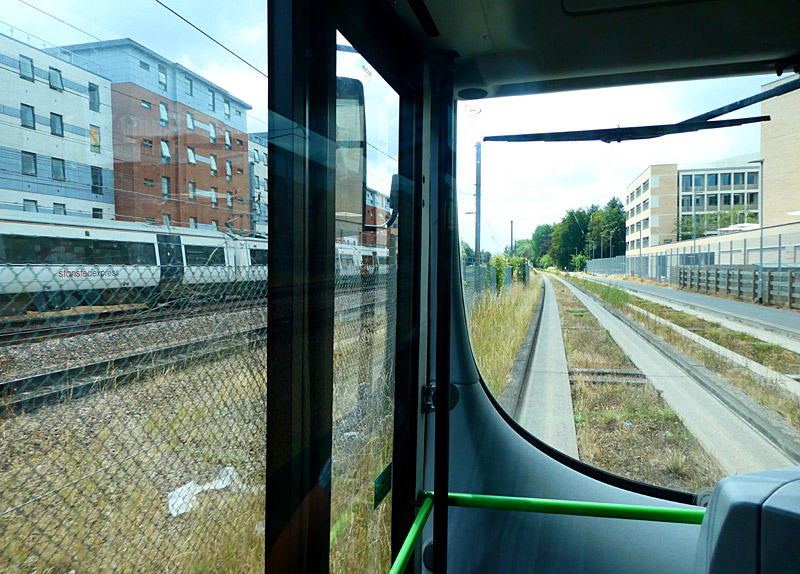 |
|
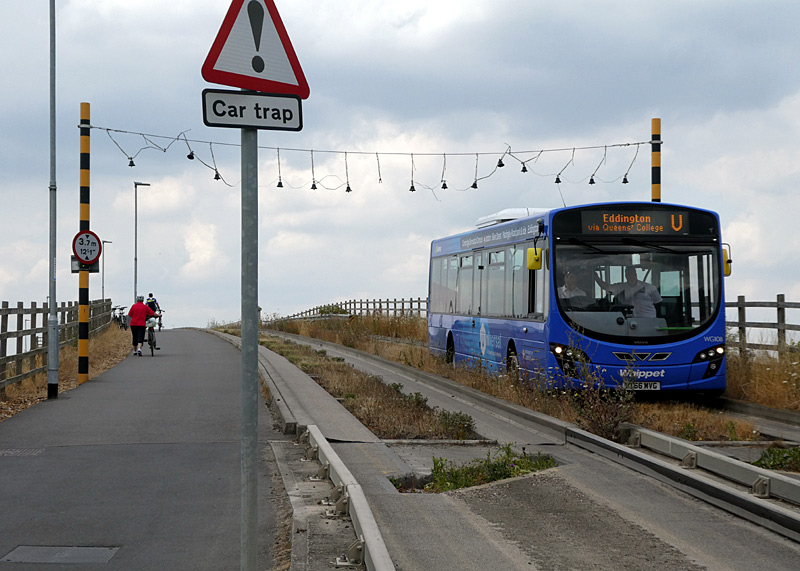 |
|||
| In Cambridge city centre the busway is alongside the railway. | |
Go Whippet bus on route U descends a bridge over the railway. | |||
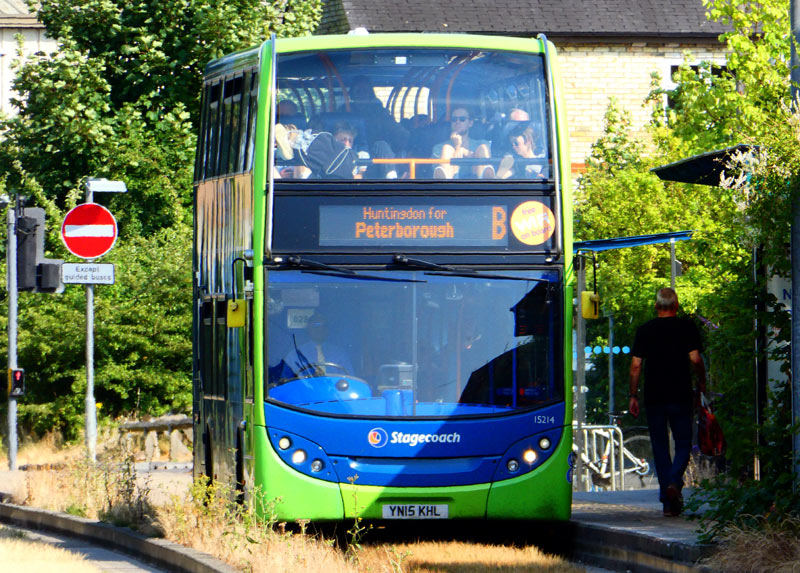 |
|
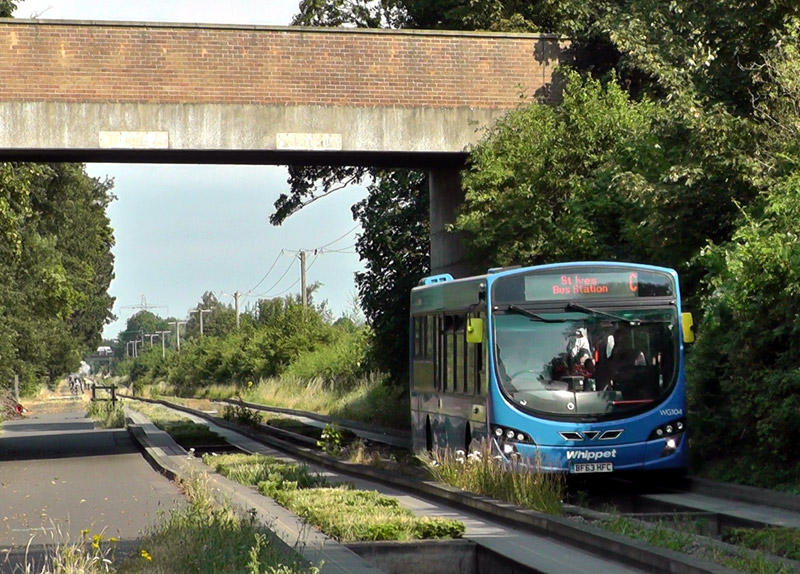 |
|||
| Stagecoach operates a mix of single and double deck buses. | |
Go Whippet bus on route C. This was filmed in summer 2018, since when route C has been withdrawn. | |||
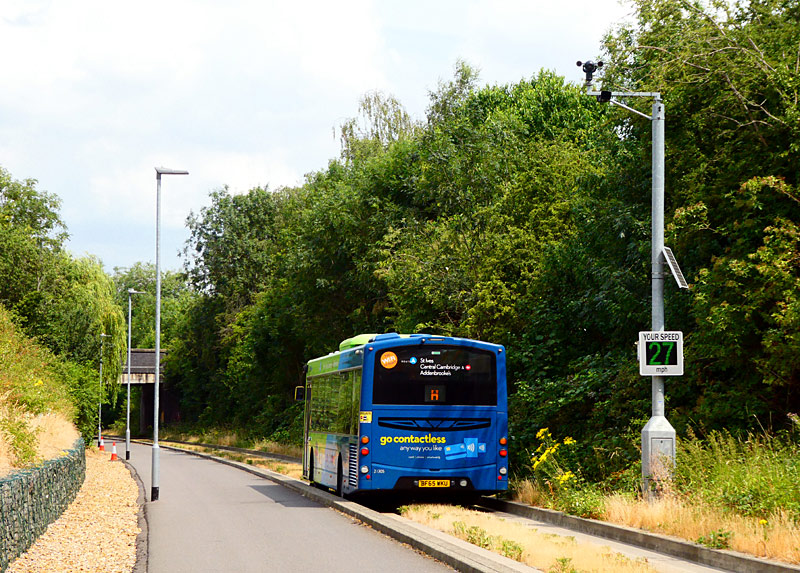 |
|
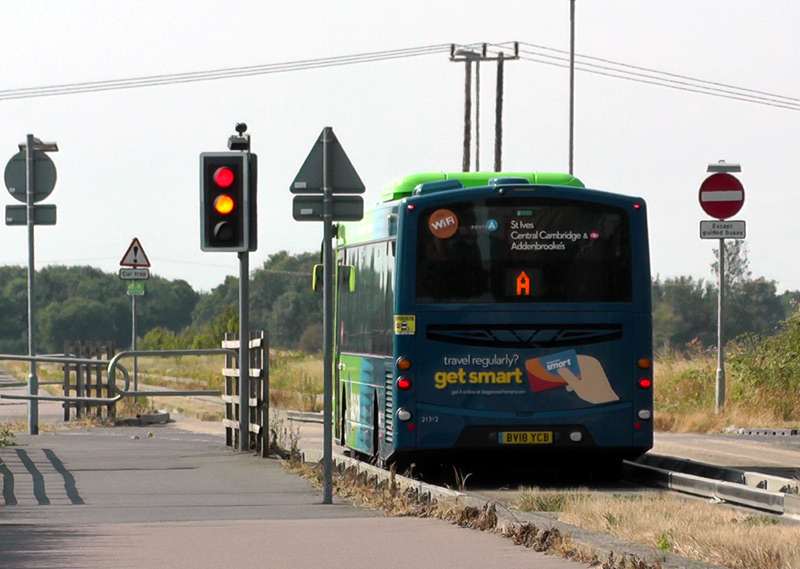 |
|||
| Speed cameras are used on the busway! This example was seen where limited space on the former railway alingment at Trumpington meant that to retain space for pedestrians and cyclists the buses have to use a bi-directional section of single track busway. | |
A traffic signalled junction - the lights change to green on the approach of the buses, but the process is so slow that buses are still forced to stop before proceeding - presumeably this is a planned safety feature designed to protect buses from road traffic which ignores red traffic signals. | |||
The Luton - Dunstable Kerb Guided busway opened in September 2013 and is served by three bus operators; Arriva, Centrebus and Grant Palmer. Part of this busway reused a closed section of railway. When it was open the railway service had included some trains which used the 'Metropolitan Widened Lines' that had been built by the Metropolitan Railway between London's Kings Cross and Mooorgate stations. |
|||||
 |
|
 |
|||
| An eastbound (towards Luton) Centrebus service E about to arrive at the White Lion Retail Park guided bus stop. This is the only eastbound bus route that calls here; all other eastbound buses divert via Dunstable town centre and rejoin the guided busway elsewhere. However all westbound buses call here - some do so twice, as after their first visit they then travel through Dunstable town centre before passing here a second time on their way to their ultimate destinations! | |
Bus stop signage at the eastbound White Lion Retail Park guided bus stop, showing the real-time travel information, a local area map, the Busway logo and timetables. On the left is an additional note advising passengers that eastbound Arriva buses do not stop here and suggesting two alternative bus stops. | |||
 |
|
 |
|||
| A Grant Palmer bus midway between Clifton Road and Luton Station Interchange. | |
Arriva bus at the Clifton Road guided bus stop. This BRT busway includes four of these 'high quality' style bus stops, although with open (unprotected) sides and front the "glitzy & shiny" platform shelters are actually less
functional and offer less weather protection (especially from cold winds and squally rain showers) than the bus stop shelters on some of the other British BRT systems.
Bus stop shelters are looked at on the Shelters & Waiting Rooms page. |
|||
 |
|
 |
|||
| These strange-looking metallic contraptions are to be found at every pedestrian access to the busway - including bus stops and the combined cycleway & footpath which runs alongside the entire length of the guided busway. This example is at the Stanton Road bus stop. | |
Promotional sign on the platform at the Portland Ride bus stop. | |||
The Bristol Metrobus system opened in stages in 2018 and 2019. It comprises three bus routes with 1.2 miles of kerb guided busway (with adjacent pedestrian and cycle lanes) split in multiple sections. The project also included new and upgraded bus stops and installation of real time information displays. Although intended as a BRT - Bus Rapid Transit - project Metrobus has suffered from what can be described as 'project creep'. In short, the bus priority aspect of the project has not been sufficiently realised to avoid buses suffering sometimes lengthy delays from traffic congestion. In an open letter published in January 2020 the managing director (James Freeman) of the bus company which operates the Metrobus service (First West of England) replied to complaints about late-running buses pointing out that his services could not operate properly because of roadworks and general traffic congestion. He added that because of insufficient bus priority measures the £230m of public money invested in the project had been "largely wasted". By way of contrast critics of the Metrobus system have been vociferous in complaining that the BRT project has caused the loss of small holdings, long-held allotments, green belt land, a community food growing project and more. Bristol is an important city, perhaps some underground alignments would have offered a better solution? Ideally using a mix of higher capacity multi-articulated buses and double deck buses according to the routes being served. Essen proved that buses can travel undergound and interact with safety signalling systems. These four Bristol Metrobus photographs: image & license: Geof Sheppard / Wikipedia encyclopædia.
CC-BY-SA-4.0 |
|||||
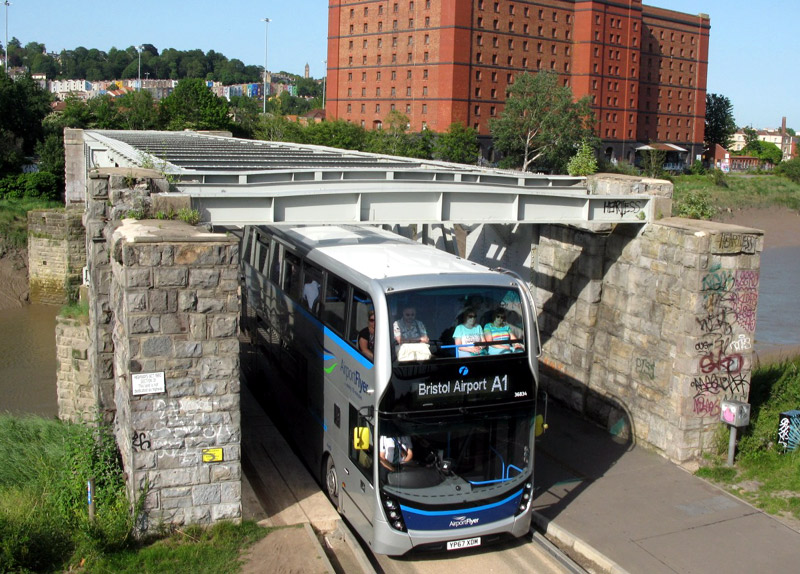 |
|
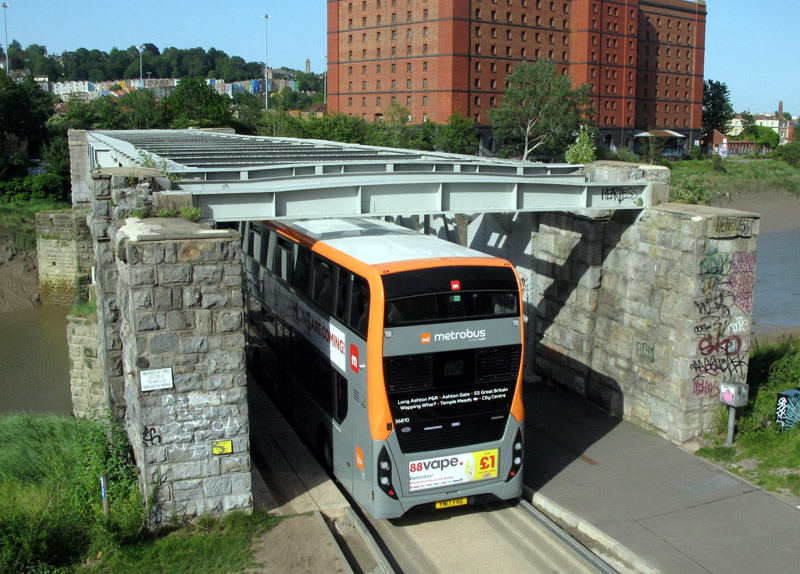 |
|||
| A bi-directional section of busway at the Ashton Avenue Bridge. | |||||
 |
|
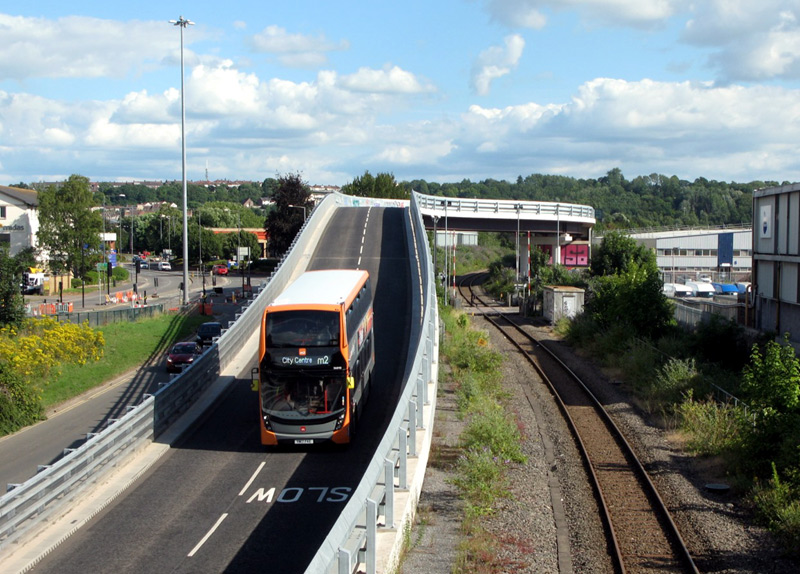 |
|||
| A metrobus stop at Ashton Gate in Bristol. This is on the guided busway section of route m2 from Long Ashton to the city centre. | |
The viaduct at Ashton Gate, Bristol, which carries a bus lane over the Portishead branch line and a local road. | |||
Important "Why" CommentsFollowing the opening of the first part of the Cambridgeshire kerb guided busway I was invited to join in a short discussion about kerb guided busways on BBC Three Counties Radio, which includes Luton in the area it serves. This was because some local people were questioning *why* the Luton - Dunstable busway could not just be 'driver steered', similar to the Runcorn / Kent Fastrack / Landore Express / Eclipse busways (etc.,) Of course this would have been possible, but even if a former railway was being rebuilt for a driver steered busway the project would still cost many £millions. Because of the way project costs can overrun in different ways depending on what is being built we will never know (for sure) whether by opting for kerb guidance money is being saved over a normal driver steered busway. However since self-steered track guided buses require less road 'width' so there could be a greater possibility of financial savings at space-restricted locations where otherwise expensive widening would be required. That said, it is worth noting that to reduce construction costs at a space constricted location even the Cambridgeshire kerb guided busway includes a section of traffic signal controlled bi-directional single track. But this was primarily so that there would also be space for a footway / cycle path alongside the bus trackage. What we can say however is that kerb guided busways do offer advantages. These include a higher quality of ride than on a normal driver-steered asphalt roadway, safer travelling permitting higher speeds and a higher 'status'. The latter is not simply the 'kudos' of being something a step above a normal busway, but that the 'fixed infrastructure' implies that a commitment has been made to the target population. Compare the images of the guided bus track to that of the driver steered bus-only roads - which in reality look like normal roads... that may not even be dedicated busways! The Aim is Also Important. Better Service - Or Cleaner Urban Air? - With A 'Can-Do' Attitude It Is Possible To Have Both!Also important is the aim / intended end result in the investment in the public transport. To provide a better, more reliable bus service which is less likely to suffer from congestion, then the kerb guided system offers a superb solution. Even if, as on the Cambridgeshire busway, actual journey times are broadly similar to off-peak road bus services. However, if the aim is to reduce urban air pollution and consequential human ill health then electrically powered trolleybuses are the solution. The latest examples often feature powerful batteries so that only part of the route actually needs equipping with overhead wires. This is a win-win solution that also sees the batteries being recharged whilst the bus is running in trolleybus mode and therefore also overcomes the daily range limitation of battery buses. It is fully compatible with buses that are kerb guided or driver steered. The only hurdle comes from human thinking - and closed-mind dogmatic 'not invented here' points of view. |
|||||
Magnetic Under-Road Wire GuidanceThe kerb guided busway is mechanical in operation, ie: it requires physical contact with fixed infrastructure. An alternative to this is a system whereby otherwise ordinary buses are 'invisibly' steered by magnetically locking onto wires located just below the road surface. The idea is not new - it has been used in industrial applications for many years - but the transition to passenger transport has been very slow. How It WorksThe basic premise is that a low level current is passed through a cable buried just beneath the road surface, and this generates a magnetic field which is detected by antennae located under the front of the bus. These antennae are linked in to on-board computers which control the steering via hydraulics specially installed for the purpose. The system is activated / de-activated by means of a simple press button so buses can switch between guided and non-guided operation while on the move however, at all times the bus drivers continue to control the vehicle's speed, and should the need arise can over-ride the automatic steering. If there is a fault both audible and visual alarms will activate, advising the driver to resume manual steering immediately. The cable is powered by transmitters which would be required every 2-3 miles. These could be housed anywhere convenient, with perhaps anonymous nearby buildings being more secure (from vandalism) than roadside facilities. To ensure safety in case of power failure (which could lead to a sudden and catastrophic loss of guidance control - imagine for instance this occurring on a high-speed bend) the transmitters could be powered by an uninterruptible power source, similar to those used on burglar alarms and many computer systems. Various countries have tested the technology at factory test tracks; in Sweden Volvo developed a version that was much simpler in concept than the others, and the opening, in 1979, of a small scale public installation meant that it became the first version to achieve passenger-carrying trials. Located in the south-western coastal town of Halmstad its purpose was to provide exact docking at bus stops, thereby providing level entry at a time long before the concept of the low floor bus had been thought of. Just eight buses were involved and in addition to the necessary equipment for the wire guidance they were also fitted with hydraulic plates which covered the steps (required for use at 'ordinary' bus stops without raised platforms) and formed a bridge to the platform edge. In service both technologies worked, but the wire guidance was not an overriding success because it seems that many of the drivers did not quite trust the electronics and being concerned about what they saw as the near certainty of colliding with the platform often kept a grip on the steering wheel. As a result many of them developed shoulder problems. This problem was severe enough to cause the abandonment of the guidance facilities, (surely if they had been properly trained this situation would not have arisen?) but until the recent advent of low-floor buses the raised platforms continued to be used with the hydraulic plates continuing to ensure level access. (Sorry, not illustrated.) In 1984/5 there was also a small demonstration system in the German town of Fürth, which is near to Nuremberg. However, it did not achieve the same acclaim as the rival O-Bahn demonstration system in Essen and is now closed. So far none of the originally planned 'serious' public installations have actually been built. (Again, apologies not illustrated.) In 1996 there was also a trade demonstration installation in Newcastle Upon Tyne, which was designed to give the British bus industry confidence that the technology was viable, suitable for its intended purpose, and safe! Lasting for about two months it used an Optare Prisma bodied Mercedes-Benz 0405 citybus which had been modified by a Mercedes dealer (in Leeds, which is about 90 miles [150km] away! - erm, are there really no Mercedes-Benz bus dealers in Newcastle??) and included simulated emergency stops, passing loops, ‘S’ bends, becoming guided while driving at speed, stopping at 'level entry' kerbside bus stops, etc. These trials were successful; on attempting to steer the bus off-course drivers found that considerable effort was required to get it to deviate from its predetermined route, although there is a 'panic' button for emergency situations when 'instant' steering control might be needed; this is in addition to the main dashboard controls which are also required for switching between frequencies at passing loops and / or route bifurcation's. Experience also showed that under normal circumstances a modest speed of 50 mph (80km/h) could be achieved, one thing the technology is not designed to allow is reversing. Not included in these trials was whether the system can cope with wintry weather, when roads can become as slippery as ice rinks - the question being whether the magnetics would be powerful enough to hold the bus to its predetermined course, or whether - in common with all other rubber-tyred vehicles - the buses will have to slow down to a snail's pace. The wire guidance system used here is by AEG (a Mercedes-Benz sister company within the Daimler-Benz group) and differs from the others because it uses two cables laid about 30 centimetres (approximately 12") apart. It is claimed that carrying the guidance signal in a parallel loop makes the system much more resistant to interference from surrounding conductors, such as structural steelwork. This system also features in what has become the first 'serious' use of electronic guidance for any form of passenger transport. This is in the service bore of the Anglo-French Channel Tunnel. The Channel Tunnel consists of three independent 'tubes' about 50 km long which are linked every 375 metres by cross passages. The outer two each carry a single track rail line while the centre one has various functions including acting as the fresh air duct, carrying the drainage and other services pipework and being a 'safe haven' in case of emergency. Because of the length of the tunnels there is a need for some sort of powered maintenance vehicle and this is provided by a fleet of specially constructed Service Tunnel Transport System vehicles (STTS). It is these vehicles which use the wire guidance. The reason for using any form of guidance system is that it provides the only safe way to maintain unhindered two-way operation of the rubber-tyred STTS vehicles within the 3.6 metre wide roadspace. Wire guidance was chosen after evaluating all the (then) possible alternatives, including kerb guidance, the GLT/TVR and a system that would have seen the vehicles steered by infrastructure fitted inside the tunnel walls. Originally narrow-gauge rail vehicles were proposed, they were rejected for a number of reasons including the extra expense of maintaining the fixed infrastructure - which to avoid a tripping hazard would have had to be sunk in the tunnel surface; the perceived danger of long braking distances either requiring the installation of some sort of signalling system or for 'driving on sight' mode the keeping to a low speed (surely tram - style magnetic brakes would have been an alternative solution?); and the inability to separate individual wagons and change the order easily - for instance, if an ambulance wagon is at the rear of the train it would be extremely difficult to detach it and pass it to the front. As a contrast with rubber-tyred vehicles it would be much easier to drive round the ambulance wagon, or if it was self-propelled for it to drive round the other vehicles. |
|||||
 |
|
 |
|||
| Schematic showing how the system works. | |
Rubber-tyred STTS vehicles in the service tunnel. | |||
Images sourced from a brochure issued by the electronic wire-guidance manufacturer.
The very restricted space within the tunnel meant that the STTS vehicles had to be of a novel design. Operating within a tunnel of only 4.8 metres diameter required that to reverse direction they could be no more than 3 metres long, which was deemed to be insufficient to be practical, so instead they are double-ended. For safety both axles are lockable, with interlocks preventing the engine from being started from the front cab if the rear axle is unlocked. Traction is via a 5 cylinder 3 litre indirect diesel engine and to ensure that the exhaust fumes are at an absolute minimum each vehicle is fitted with waste gas detectors. The choice of traction is somewhat surprising for a vehicle that operates underground but it was felt that the length of the tunnel was too great for battery power (the weight of which would also have considerably restricted the vehicle's payload) while overhead wire (etc.,) systems would have interfered with access to the various services in the crown of the tunnel. (Presumably LPG / CNG gas fuels were discounted for safety reasons, in the same way as private vehicles using these fuels are also prohibited from the car-on-train 'shuttle' services). These vehicles do not carry fare paying passengers, rather they are specifically for services personnel, emergency services (fire and ambulance) and customs officials to use when travelling within the service tunnel. They are modular in design with removable central sections making them multi-tasking depending on the specific requirements of the day. In the event of a major incident train passengers would be evacuated from a stricken train into the service tunnel and then out via a rescue train located in the other rail tunnel, it is not intended that passengers would evacuate in the STTS. Public Transport BRT Demonstration SystemIn 1999 an 0.8mile (1.3km) section of wire-guided busway was installed in London, this being intended to be a feature of the two 'high profile' showcase BRT services serving the Millennium Dome, which was located on London's previously derelict Greenwich Peninsula. Note that although the Millennium Dome has now been renamed The O2 the previous name is being used here, as this more accurately reflects the name of the structure at the time of the events being described. The idea was to create a public demonstration system showing just how good bus-based public transport can be. As with the Dome the two special bus services were enthusiastically supported by the national government, so there was no problem funding the 17 brand new vehicles required. These 12-metre East Lancs Myllennium bodied DAF Bus SB220LF low floor buses were very luxuriously appointed featuring very comfortable seating, full air-conditioning, audio-visual passenger information systems and double-glazed Flyte bodies. In an attempt to enhance their environmental credentials three of them were LGP powered whilst the rest used ultra-low sulphur diesel. They were operated by Go-Ahead subsidiary London Central under contract to London Transport Buses. Apparently the 'Myllennium' buses were specially designed for the two Millennium Dome bus routes, although subsequently they were made generally available. Only one of the two special Dome bus routes was planned to use the guided busway and this service linked Charlton railway station with The Dome via a mix of dedicated busway and normal roads which featured enhanced bus priority measures. |
|||||
|
|
|
|||
 |
|
 |
|||
| Two views from December 1999 showing wire-guided buses on test calling at a bus stop with a special railway-style 'raised platform' designed to provide level access. | |||||
|
The busway was formed of a special high resistance anti-skid block paving laid in a herringbone pattern, under which the guidance cables were invisibly fitted. Although this paving would have reduced the ride quality the short distance and low speed meant it would not have been a major issue. This choice of road surface was influenced by a desire to avoid 'rutting' - a common problem with bus lanes - caused by the vehicles' rubber tyres only using the same narrow strips of roadway. The busway included two stops with mini platforms offering level access with the bus. Among the reasons for choosing to use under-road guidance technology here were:-
Apparently the original idea had been to use guided trolleybuses, or even trams, but because planning for the transport link was only started 16 months before it had to open it was deemed that there would not be enough time to comply with the cumbersome British legislative requirements for new 'fixed infrastructure' transport systems which involve overhead-wire. This is a most strange excuse because the Dome's promoters were able to obtain the required Parliamentary powers to get the heavily polluted land cleared and the Dome designed, built and opened all in a very short time scale, showing what can be done if there is a political will to do it. In August 2003 the Swedish town of Landskrona opened a completely new trolleybus system which had been successfully designed and installed in just one year from when the city council voted for it - what a contrast with the British planning process which encourages paralysis by analysis!!! |
|||||
 |
|
Overview of the wire-guided buses bus station outside the Millennium Dome. The bus seen on the far left with its back facing the camera is calling at the pick-up point for passengers wanting to travel on route M1. Immediately behind is the drop-off point for arriving passengers. '1' and '2' are where the roadway had to be widened (see below) whilst the red arrowhead points to the cabinets which contained the electrical control gear for the wire guidance system. |
|||
Erm, Into Public Service?The guided busway was expected to have opened to fare paying passengers at the same time as the Dome, (ie: 1st January 2000!) but whilst the special buses did enter passenger service (using the public highway) the busway remained closed for further testing. Unconfirmed reports (rumours) for this varied. One suggestion was that the tracks had been put too close together for buses to pass safely! Whether or not this is true remains unknown, although later on some online discussion revealed that at some stage the original large wing mirrors on the buses were replaced by much smaller standard bus mirrors, which would indeed improve clearance. Other rumours suggested that the delay was caused by problems with buses 'touching' the platforms at the Millennium Village stop if they pass through at 'normal' speed without stopping. Whatever the reality, on a visit early in February 2000 it was noted that some road widening / kerb realignment was underway near the terminus at the Dome where buses perform a right-hand 'u'-turn, and where the 'u'-turn area narrows (for the road to become just 'two lanes' wide again). Both sets of works were well fenced-in with heavy tarpaulin covering the wire mesh - presumably to hide what was being done. The photographs (below) were taken on a very windy day when some of the fencing had been blown down. Much to my amazement when one of the workmen saw me using a camera he became very agitated, making it quite clear that he did not want me to take any photos; on attempting to speak to him (to ask him why 'no photos') he became exceptionally hostile and fearing for my own safety I left the area (in a hurry!). At the time such behaviour seemed more reminiscent of a petty official in a tinpot dictatorship than a nation that prides itself as a bastion of the free world - although since the 9/11 events in the USA this type of hostility towards people using cameras (especially near to locations served by public transport) has become commonplace. The petty officials and police often cite 'security' reasons, but they seem to have forgotten that mobile phone cameras and near-invisible shirt button cameras are easily obtainable by those whose intentions are dishonourable. These works were very close to the inconspicuous grey boxes where a few weeks earlier some workmen had been seen tinkering - these boxes contain electronic control gear for the guided busway and the workmen were probably carrying out remedial works to cure some problems. The hostility shown to me was consistent with someone with 'something to hide' - perhaps the private consortia behind the guided busway had their 'backs to the wall' and were embarrassed that the system was not yet operational. It may also be significant that just days earlier the Dome announced disastrous attendance figures (which could have been attributed to exceptionally negative press reviews and the usual 'New Year' slowdown in the travel / leisure industry) and had to seek a £60 million 'short term loan', plus the Government had replaced the boss of the company that runs it with someone from the Disney (Mickey Mouse, etc.,) organisation. |
|||||
 |
|
 |
|||
| Two views of widening works in progress. Both images come from position '1'. Just visible in the view on the right are some tyre marks which show just how close the buses' wheels came to the kerb before the road was widened. |
|||||
 |
|
 |
|||
| Passing position '1' after the works had been completed. | |
A bus at position '2' leaves the bus station and heads back to the main part of the busway and Charlton Station. (Seen whilst under test). | |||
 |
|
 |
|||
Summer 2000. With the busway still closed for testing a bus calls at the "set down platform" at the Millennium Dome terminus demonstrating just how closely
the 'drive by wire' technology can dock a bus to the kerb.
Even after these works the busway remained out of use and by September it was announced that 'insurmountable technical difficulties' had forced a 10-12 month postponement of the plans for the buses to use electronic guidance. Some reports suggested that new parts were required, and the delay was caused because it would take this long to design, manufacture and install them. Other reports suggested an official admission that the technology was not ready and would need another couple of years' development, By December the scheme had been quietly shelved. The Dome (which had been intended as a focus for the nation's celebrations for the year 2000 and together with its internal exhibits was only just completed 'in the nick of time') had been a financial disaster with attendance figures about half of the original estimates, and whilst the BRT demonstration system had only been partially realised a new electric tram / light rail line that had opened during the year in Croydon was proving far more successful than either the Dome or its bus services. Whilst it could be that the exceptionally hostile press reviews§ were to blame for poor attendances, it seems most of the people who actually visited The Dome were impressed by what they saw. (As an aside, the Expo 2000 in Hannover, Germany was also a technical success but financial failure). §It is very possible that the hostile press reviews can be attributed to 'revenge' after the three [3] hour delays[!] many invited guests - including many newspaper feature writers and editors - suffered on their way to The Dome on its opening night. One unexpected problem for the guided busway (virtually a final nail in the coffin) was that the body under whose jurisdiction the safety of new 'fixed infrastructure transports' - including all types of guided bus technology - fell at the that time (Her Majesty's Railway Inspectorate - HMRI) wanted to apply railway-style safety criteria, which with hindsight may not have been the ideal solution for a bus transport. Of particular concern here was what would happen in the event of a sudden failure in the guidance system and how the driver would react. Reports vary, with one suggestion being that the issue was whether such a failure would be to 'safe' (ie: retain some sort of guidance or automatically stop before 'derailing' and without the danger of a vehicle behind crashing into it) or 'danger' (ie: guidance fails and vehicle is unsteered until the driver retakes control). With road transports most failures are to 'danger'!. Other reports suggest that the guidance system was designed on the assumption that the bus driver would maintain a high level of vigilance and therefore in the event of any emergency (such as a vehicle in a side road not waiting for the bus to pass before pulling out in front of it) so a reaction time of 0.6 second would be allowed for the bus driver to take the appropriate action (in this case, make an emergency stop). However, it seems that the Railway Inspectorate used the much longer railway response time of 2½ seconds, which works well for sighting signals, etc., on the railway, but is too long for a road vehicle. This mismatch of safety criteria vastly impacted requirements for system intelligence with situations which would not have been critical for the shorter response time becoming major challenges for the system. Using the same example as above, 2½ seconds would have been far too long to allow the driver to react, so by implication some sort of electronic obstacle detection and avoidance technology was now deemed to be required. Long Term UseOnce the Millennium celebrations were over Transport for London published proposals to use this busway as part of a regional transport system (provisionally called Waterfront Transit) that will link both sides of the River Thames via public transport only lanes on a new bridge. If these proposals come to fruition they may even feature articulated trolleybuses / duo-buses or trams (the whole route was built to meet tramway standards regarding curves and gradients). We shall see... One thing is certain however, having had its fingers well and truly burnt under-road wire guidance is not on the agenda. |
|||||
 |
|
 |
|||
| April 2001 and the never opened busway is being dismantled. | |
The would-have-been 'guided' busway has now been rebuilt and is being used by ordinary local buses in 'driver steered' mode. | |||
It was originally planned that the two special Millennium Dome bus services (M1 & M2) would cease to operate after the Millennium celebrations had finished and once the Dome had been closed. However during the year of their operation many local people found that especially route M1 provided them with an excellent transport link as a feeder into the Jubilee Line Underground station. So whilst the two Dome bus routes did indeed cease on 23rd February 2001 route M1 was replaced with bus route 486 which also served local hospitals and other destinations in south-east London. Initially the 486 used the same buses, making it one of the few bus routes in London (at that time) to use full size single deck buses. However the buses became somewhat temperamental and at times had to be substituted with double deck buses. The LPG buses were especially unreliable and their lack of opening windows combined with the air conditioning seeming to have been disconnected resulted in them being somewhat uncomfortable in the warmer weather. When in February 2007 the bus service contract was renewed the opportunity was taken to formally replace the Millennium Dome buses with standard double deckers. In the meantime on the 2nd June 2001 the busway was reopened, this time for 'driver steered' buses. As these images suggest, several bus routes now use this busway, although there are problems at some of the 'level crossings' (traffic signal controlled road junctions) where the buses often spend several minutes at a time sitting at red traffic signals. RepercussionsFollowing the total abandonment of the wire guidance on the Dome busway the Riverside Transit scheme in Newcastle-Upon-Tyne has opened using visually distinctive driver steered Designline diesel-electric hybrid buses sourced from New Zealand. Hybrid buses are looked at on another page. In London the proposed use of wire guidance on the East London Transit bus scheme which would have seen wire guided trolleybuses using the public highway, has been demoted to become little more than a high profile conversion and possible extension of bus route 369 / shortening of other bus routes, retaining the use of ordinary driver steered motorbuses. "Questionable Integrity"?Regarding the East London Transit bus scheme it can be alleged (but not proven) that there might also have been an element of "questionable integrity" with respect to wanting to use wire guidance and systems installation costs. Pages 27 and 35 (plus others) of the East London Transit - Summary Report as issued by TfL in July 2001 make it quite clear that the cost of the trolleybus option included under-road electronic guidance. But trolleybuses do not need such guidance (the bus driver can do that!) and it could be said that the inclusion of this has only acted to deflect the installation costs upwards. This leads to the question "were the reasons for specifying the unnecessary guidance system to sabotage the trolleybus option by making it appear more expensive than it need be?"
October 2007 UpdateThese views from October 2007 show that the former guided busway is now just an ordinary bus-only road flanked on one side by a road which is open to all vehicles. So although a quick glance may make it look like this is a normal dual carriageway it is actually two single carriageway bi-directional roads. As the images below suggest, sometimes the buses use both carriageways...and so do some private cars! Although theoretically private bus-only roads should be about 'rapid' transit the combination of the decidedly slothful low speed limit - just 30mph (50km/h) and long delays sitting at red traffic signals - even when there is no other traffic using the junctions - means that the services which use this busway are anything but 'rapid'. |
|||||
 |
|
 |
|||
| As these October 2007 images show, some buses use both carriageways.
The buses in the image above right and in both images below have been caught at red traffic signals, which operate for the two carriageways independently. At times travelling along the busway can seem to be a slower experience than the term Bus Rapid Transport would first suggest. This is mainly because of the excessive amount of time spent sitting at the various sets of traffic signals which are located at both ends as well along the length of the busway. On speaking to people with local knowledge it seems that one of the side roads (which leads to a pub and a few houses) is protected by a gate and even when that gate is closed the traffic signals will still include this turning as part of the sequence. It can be very frustrating for passengers to be sitting in a bus for several minutes at a time whilst waiting for traffic signals to cycle to green - especially when (as observed) there is no other traffic using the junction. |
|||||
|
|
 |
|||
| The image above right shows one of several private cars which in the space of an hour was observed using the bus-only carriageway. This unauthorised access might be
because some drivers mistakenly see the twin carriageway roads as being a dual-carriageway, instead of separate bus-only and public carriageways. Perhaps this is because the road signs and markings are not as clear / easy to see as they need to be, although it would also help if car drivers were more observant - and actually understood the road signs (which amazingly they sometimes do not!) To make identification less easy the car was allowed to travel a distance away from the camera before the image was captured. Magnetic Under-Road Beacon GuidanceIn Holland an attempt to create a busway system where the buses could be operated fully automatically included a fleet of 13 distinctively styled motorbuses which ran under the marketing name of 'Phileas'. The demonstration system was along a private busway which links Eindhoven City Centre with its airport and Veldhoven. The plan included the use of a pioneering electronic guidance technology based on magnetic beacons, which was known as FROG - this being an acronym for Free Ranging On Grid navigation technology. Phileas buses were just one of several bus services to use FROG - the others included the ParkShuttle bus at Amsterdam Schipol airport and Rivium plus a former experimental installation in the (French) Antibes. FROG used magnets which were embedded (at 4m intervals) in the concrete road surface. These were detected by the on-board computer system which was also programmed with details of the route to be followed. The computers also monitored wheel revolutions, as this provided precise location information and helped the computer guide the buses both along the correct route and into bus stops. FROG was a commercial product of an Utrecht-based company called Frog Navigation Systems, who also traded as 2gethere. |
|||||
To avoid too much duplication FROG is looked at in greater detail (together with the Phileas buses) on the Hi-tech New-era buses page. A Dutch 'Phileas' bus on a BRT-style bus-only road on route 401 which links Eindhoven Airport with the city centre and the bus station, which for ease of interchange is located right next to the railway station. |
|
 |
|||

Direct links to other Buses pages...
- Main Buses Page.
- Carrying The Crowds.
- A Bus For London.
- Electric Buses.
- Hybrid & Tribrid Buses.
- New-era Hi-tech Buses.
 |
|
|
|
|
|
|
|
|
|
|
|
|
|
|
|
|
|
|
|
|
|
|
|
|
|
|
|
|
|
|
|
|
|
|
|
|
|
|
|
|
|
|
|
|
|
|
|
|
|
|
|
|
|
 |
|
||||||||||||||||||||||||||||||||||||||||||||||||||||
 |
 |
 |
 |
 |
 |
 |
 |
|
|||||||||||||||||||||||||||||||||||||||||||||
 |
 |
 |
|
||||||||||||||||||||||||||||||||||||||||||||||||||
 |
 |
 |
|
||||||||||||||||||||||||||||||||||||||||||||||||||
 |
 |
 |
 |
 |
 |
|
|||||||||||||||||||||||||||||||||||||||||||||||
 |
 |
|
|||||||||||||||||||||||||||||||||||||||||||||||||||
 |
 |
 |
|
||||||||||||||||||||||||||||||||||||||||||||||||||
 |
 |
|
|||||||||||||||||||||||||||||||||||||||||||||||||||
 |
 |
|
|||||||||||||||||||||||||||||||||||||||||||||||||||
 |
|
||||||||||||||||||||||||||||||||||||||||||||||||||||
 |
 |
 |
|
||||||||||||||||||||||||||||||||||||||||||||||||||
 |
 |
|
|||||||||||||||||||||||||||||||||||||||||||||||||||
 |
 |
 |
|
||||||||||||||||||||||||||||||||||||||||||||||||||
 |
|
||||||||||||||||||||||||||||||||||||||||||||||||||||
 |
 |
|
|||||||||||||||||||||||||||||||||||||||||||||||||||
 |
 |
 |
|
||||||||||||||||||||||||||||||||||||||||||||||||||
 |
 |
 |
|
||||||||||||||||||||||||||||||||||||||||||||||||||
 |
 |
 |
|
||||||||||||||||||||||||||||||||||||||||||||||||||
 |
 |
 |
|
||||||||||||||||||||||||||||||||||||||||||||||||||
 |
|
||||||||||||||||||||||||||||||||||||||||||||||||||||
 |
 |
 |
|
||||||||||||||||||||||||||||||||||||||||||||||||||
 |
|
||||||||||||||||||||||||||||||||||||||||||||||||||||
 |
|
||||||||||||||||||||||||||||||||||||||||||||||||||||
 |
|
||||||||||||||||||||||||||||||||||||||||||||||||||||
 |
 |
 |
|
||||||||||||||||||||||||||||||||||||||||||||||||||
 |
 |
 |
|
||||||||||||||||||||||||||||||||||||||||||||||||||
 |
|
||||||||||||||||||||||||||||||||||||||||||||||||||||
 |
 |
 |
 |
 |
 |
|
|||||||||||||||||||||||||||||||||||||||||||||||
 |
 |
 |
|
||||||||||||||||||||||||||||||||||||||||||||||||||
 |
|
||||||||||||||||||||||||||||||||||||||||||||||||||||
 |
 |
 |
|
||||||||||||||||||||||||||||||||||||||||||||||||||
 |
 |
|
|||||||||||||||||||||||||||||||||||||||||||||||||||
 |
 |
 |
|
||||||||||||||||||||||||||||||||||||||||||||||||||
 |
|
||||||||||||||||||||||||||||||||||||||||||||||||||||
 |
 |
 |
|
||||||||||||||||||||||||||||||||||||||||||||||||||
 |
|
||||||||||||||||||||||||||||||||||||||||||||||||||||
 |
|
||||||||||||||||||||||||||||||||||||||||||||||||||||
 |
 |
 |
|
||||||||||||||||||||||||||||||||||||||||||||||||||
 |
|
||||||||||||||||||||||||||||||||||||||||||||||||||||
 |
 |
 |
 |
 |
 |
|
|||||||||||||||||||||||||||||||||||||||||||||||
 |
|
||||||||||||||||||||||||||||||||||||||||||||||||||||
 |
|
||||||||||||||||||||||||||||||||||||||||||||||||||||
 |
|
||||||||||||||||||||||||||||||||||||||||||||||||||||
 |
 |
|
|||||||||||||||||||||||||||||||||||||||||||||||||||
 |
 |
 |
|
||||||||||||||||||||||||||||||||||||||||||||||||||
 |
|
||||||||||||||||||||||||||||||||||||||||||||||||||||
 |
|
||||||||||||||||||||||||||||||||||||||||||||||||||||
E & OE.
© Copyright 2001 - 2026 Simon P Smiler and named image sources.
Privacy Policy
