Southend Pier Railway
This page shows the several generations of rolling stock used on the pier railway at Southend-On-Sea, in the county of Essex. 1.33 miles (2.16km) long this is celebrated as being the longest leisure pier 'in the world' (some military and commercial [non-public] piers are longer). The railway is 1.25 miles (2.01km) long.
The reason why the pier is so long is that when a pier was first conceived the intended purpose was for it to act as a docking point for leisure-themed holiday steam ships coming from London. But, when the tide is low the waters recede a very significant distance from the shore and it was found that the pier needed to be extra long to reach deep enough water beyond the shallow mudflats of the Thames Estuary, as this is the only way to ensure that the ships stay afloat at all times - including at low tide.
These first images show the former electric trains that were introduced in 1949 (replacing older trains which operated a pre-war service) and in all there were four trains, each of which comprised seven four-wheel carriages. The railway features just two stations (one at each end) and - in those days - was entirely double track with X crossover junctions close to each station. With so many trains operating and both stations having two platforms there was also a colour light signalling system to keep everything running smoothly. The system was electrified at 500v dc using a centrally located third rail and the track gauge was 3ft 6in (approx 106cm). Reports I have read suggest that at busy times trains could be as frequent as every 5 minutes, with station capacity to handle the crowds also being an issue.
The line closed in the late 1970's - some reports suggest 1978 whilst others say that public services ended in October 1976 but for the benefit of the lifeboat crew some occasional trains continued to operate until July 1979. In 1986 a new two-train diesel service was opened and in 2021 two battery electric trains were introduced.
The first image dates from the late 1970's. It was taken using 126 print film and digitised in 2003 - unfortunately by which time the colours on the negative had began to "change". The rest were taken in 1982 and show the vehicles on the promenade awaiting removal for scrapping. These were taken on Kodachrome 64 film - the square shaped views on a "126" format film Instamatic camera and the other views on a "110" format camera which featured a fixed aperture but an automated electronic shutter that facilitated low-light and indoor photography without the use of flashguns. Unfortunately the limited width of the promenade prevented my walking 'back' enough to be able to source full-width side views of any of the carriages. There are no views of trains travelling between stations or arriving / departing stations.

A train (in passenger service) standing in the platform at the pier head station.
This view was taken during a lunch break on a business trip to Southend - most of which was spent getting to / from the pier. It is regretted but there simply was not the time to spend waiting to photograph moving trains. Immediately after taking this photograph the train was boarded to await the return journey.

Driving motor carriage No.22 on the promenade. This carriage is now one of the exhibits at the Southend Pier Museum
 ,
it would have been nice to have been able to include a photograph of it there however the museum's strict prohibition on visitor photography made this impossible.

Side elevation of the driver's cab showing some of the electrical control gear.

The 'inside' end of carriage No.22.
When in public service this end would be coupled to the next carriage, so it would not normally have been possible to source this type of unobstructed view.

Side elevation of carriage No.12 showing the closed sliding passenger doors.

Side elevation of carriage No.22 showing the open sliding passenger doors.

Inside carriage No.22 looking towards the driver's cab.

Inside trailer carriage No.3.

Window detail - inside carriage No.3.

Front three-quarter elevation of a works carriage.

Rear three-quarter elevation of a works carriage plus part of an adjacent trailer.

Carriages Nos 4 and 2.

A close-up view of the above image.

A side elevation of the station at the 'land' end of the pier. Some trains are just visible through the windows.
Diesel Trains
In 1986 the line was converted to 3ft (914mm) narrow gauge, rebuilt as a single track (with a passing place) and two diesel trains were introduced.
Originally these were painted red, their blue livery dates from 2006. These photographs were taken in 2009.

The two diesel trains are named - Sir John Betjeman and Sir William Haygate - as seen in this view at Shore station.

At the northern end of the train there is a driver control unit and an accessible passenger space which is reached via an extra wide four leaf folding doorway.

At the southern end of the train there is another driver control unit plus a 75HP diesel-hydraulic locomotive.

The train operator logo - this image also shows maintenance access doors to the diesel power pack.

Most carriages have twin leaf folding doors and the opening is just wide enough for a single person to pass through at a time.

Inside one of the diesel Southend Pier railway passenger carriages.

The carriage ends include windows, making it possible to see through the train.

Approaching Shore station, which is below a large pedestrian circulating area that includes the pier entrance.
The glass arch in the distance is a shopping centre named 'The Royals'.

Before reaching Shore station we passed this red train.

On this visit the tide was out - filmed from the far end of the pier.
Since the advent of the 2021 battery-electric trains the carriages from Sir John Betjemen train had their bodies removed from their chassis, with some being repurposed as
platform waiting room shelters and others were placed elsewhere around the pier head as extra seating and one of the train ends has been placed in the Southend Pier Museum.
The other train (Sir William Haygate) has been kept in fully operational condition as a backup in case of issues with the battery trains.

Two coaches from Sir John Betjeman have become platform shelters
whilst Sir William Haygate is using the other platform track.
More Electric Trains
In 2021 two new battery-electric trains were introduced. They were built by Severn Lamb, who are a specialist bespoke transport builder. These trains have six carriages trains plus a staff luggage compartment and they travel at a sedate 8-10 mph (13-16km/h). A single train can offer a 30 minute interval service whilst with both trains running the service can be quarter-hourly (15 minutes) with the trains passing each other at the passing loop.

Southend Pier with train as seen whilst walking to the pier from the town centre.
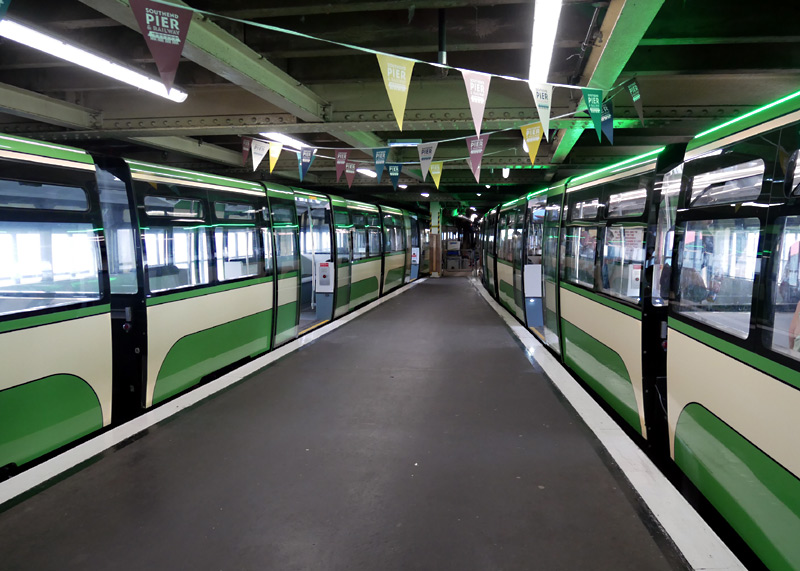
Both Southend Pier railway trains at Shore station.

Southend Pier railway train named Sir David Amess.

The other train is named William Bradley.
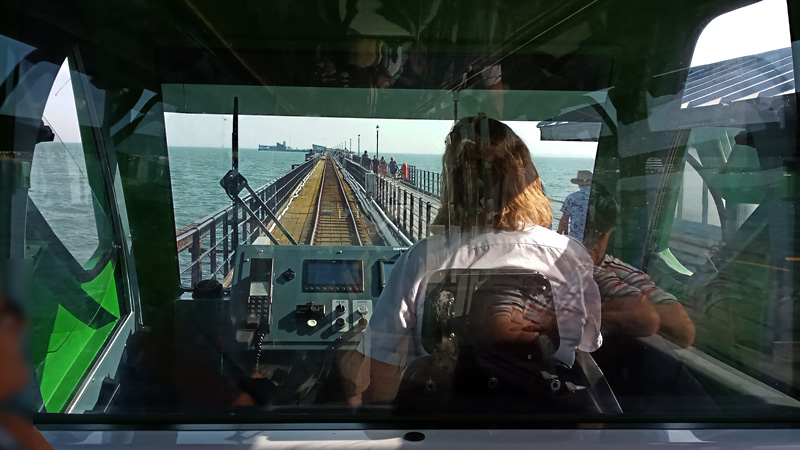
Clear line ahead!
(so there ought to be - with only one train in service!)
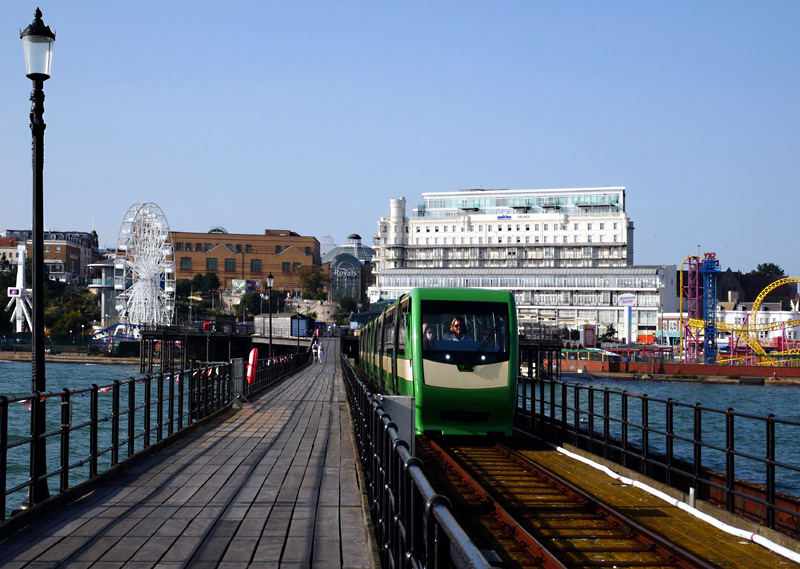
Looking towards the shore - this seaside resort's visitor attractions include a Ferris wheel (named Big Wheel) and other funfair activities.
The white lights at the front of the train suggests that it is travelling to Pier Head.

Looking towards the pier head.
The red lights at the back of the train suggest that it is mid-way en route from Shore to Pier Head stations.
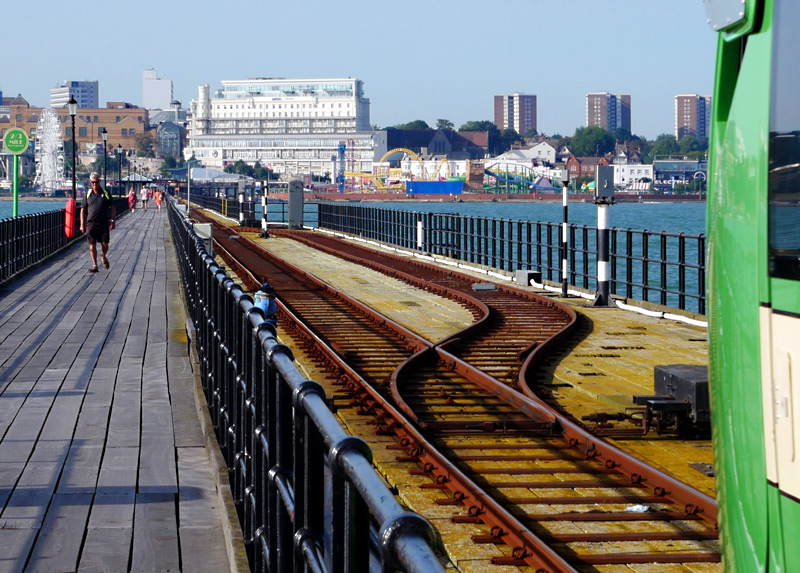
The passing loop - where two trains travelling in opposite directions pass each other.
The black and white painted posts are for the colour light signals.

Passing a sign located 1 mile from shore - the text around the bottom of the sign says: The worlds longest pleasure pier.
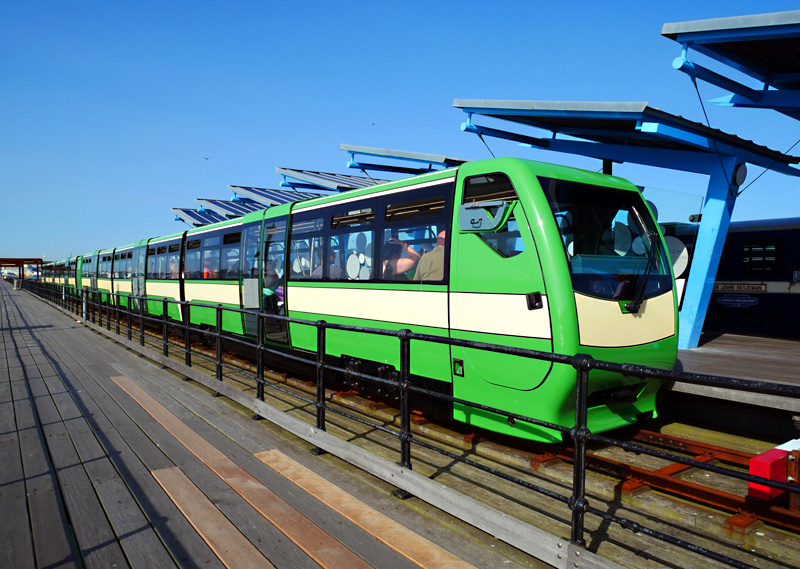
A 2021 battery-electric Southend Pier Railway train at Pier Head station.
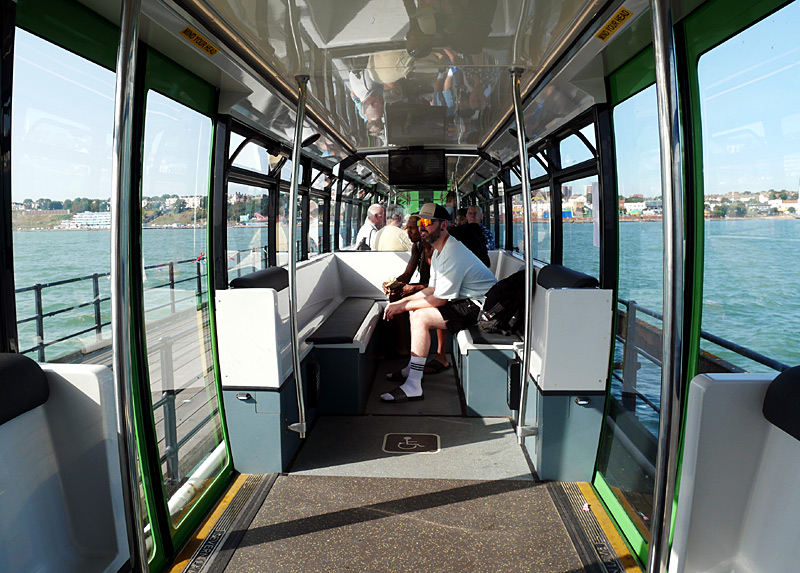
Inside one of the 2021 trains. Each train has six fully accessible passenger compartments plus a luggage area.
There is another similar seating area behind me.
This view also highlights the fact that we are travelling over the sea - and that the tide is in!
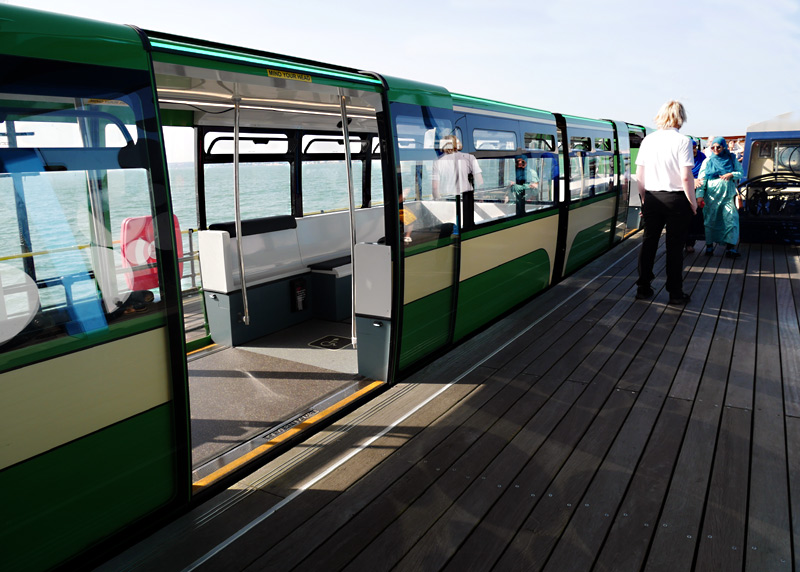
One of the battery electric trains at Pier Head station, showing the wide doorway which helps make every compartment of these trains fully accessible.
 A short film showing the Southend Pier Railway, with still images of the older trains plus much motion picture footage of a 2021 battery-electric train in action has been placed on the ‘YouTube’ film / video website and can
either be watched above or in a new window by clicking this link:
http://www.youtube.com/watch?v=xAECrJzCPzE
The 'official' Southend Pier Museum website can be found here:- http://www.southendpiermuseum.co.uk/
The Southend Pier Museum welcomes visitors, who are strongly recommended to check the website for opening days and times in advance of travelling. The museum includes three former Southend Pier electric trains, as well other items of rolling stock and displays (etc.,) which may be of interest. Visitors need to know that when I visited the museum I found that it has a very strict prohibition on personal photography.* Instead visitors are encouraged to purchase images (postcards) from the shop, which alas do not always reflect the types of detailed photographs that transport enthusiasts may wish to take. Because of this and for reasons of copyright it is regretted that this page does not include any promotional images showing the restored trains in the museum.
*) I have been told by some people that this policy has been softened. Until I get a chance to return I cannot comment on this.
This page is a branchline off the main website so after viewing it should be closed - however in case you arrived here courtesy of a search engine then this link will take you to the Albums pages index http://citytransport.info/Album.htm and this link http://citytransport.info will take to you the opening page of this website.
Click letterbox  if you wish to send me an email.
This page last updated 12th November 2026.
E & OE.
© Copyright 2001 - 2026 Simon P Smiler and named image sources.
Privacy Policy.
