Click each image to see much larger versions in new windows
- or here to see a page of large images only in this window
Historic British Rail Mk1 Carriages
Mostly Looking Inside Mk1 Carriages Showing Different Seating Layouts
Compartment And Open - And Some Other Features
The first photographs date from when the trains were in daily passenger service.
The rest of the photographs show preserved Mk1 carriages which can be found at heritage centres / living museums or are used on leisure-market services that still ply mainline railway tracks.
To avoid errors from guessing, the 'Class' numbers of the multiple-unit trains are only quoted where known.
These first images come from refurbished Mk1 based multiple-unit trains which until approximately 2005 used to operate on Southern Region third rail electric services to the south of London.

Designed for longer distance express services this carriage has three passenger doors on this side,
compartment seating at the front and open seating at the back; the frosted window is for a toilet.

The side corridor walkway.

First class, with three aside seating, fold-up armrests and individual reading lamps.

Standard class with no armrests and four aside bench type seating.
Only some carriages on these trains included compartments, others had 'open' seating, as seen in the next few images.
Again, these show the trains in their final format.

Individual seating in a refurbished open Mk1 based carriage. The seats are arranged in bays around large picture windows.

Note the ledge type table under the windowsill, these were ideal for a cup of coffee (from the refreshment trolley or retail coffee outlet at the station, as regrettably in the latter years these trains no longer had proper buffet carriages), but not much else.
This view also shows how at just 25 inches (635 mm) above the floor the lower window sill was low enough for a seated child to see out of the window - a design feature that is rarely found on present-day trains.

These trains were built with a small section dedicated to goods / freight (accessed via the double doors) and next to it a guards compartment. The guard's door has full length handles and below it are some steps so that when stabled in sidings the train could be accessed from a trackside walkway.
The need for goods areas is because when Mk1 carriages were first built passenger trains often also carried parcels, newspapers and mail bags (Royal Mail). In addition the space was used for heavy luggage, perambulators, accompanied dogs and passengers who could not access the normal passenger areas, which typically means people who used wheelchairs. This must have been extra unpleasant in the winter - as this part of the train was not heated.

In their latter years the carriage of freight was discontinued (for instance: the express parcels service ceased trading) but the space became an invaluable asset to passengers who wished to travel with their bicycles, this being a passenger-friendly feature which very few modern trains offer.
To minimise dwell times at stations multiple unit trains used on (outer) suburban services typically had doors at most seating bays.

Especially at terminus stations (as here) few passengers bothered to shut the door when leaving the train.
The closely spaced doors identify this as being an outer suburban train.
I feel sure that this was filmed at Charing Cross station. The train is in Connex livery, although I'm not sure whether it was operated by Connex SouthEastern or Connex South Central - Connex used the same livery on both their franchises.

Inside the Connex outer suburban train seen above. These had comfortable 3+2 high-backed seating and luggage racks over the seat backs.

An outer suburban train in South West Trains livery which is on a siding track (so not in passenger service) at Clapham Junction. Designed for short dwell times on suburban services this carriage has passenger doors alongside each second class seating bay plus two doors to the side corridor which serves the first class compartments. This train is a type known as Class 423/4 VEP (Vestibule Electro Pneumatic).

Inside a South West Trains outer suburban train - although the seating was the same as the Connex train, SWT used red upholstery.
Small Fleet Dedicated To The London - Gatwick Airport Service
In 1978 British Rail converted 12 VEP units into Class 427 4VEG (Vestible Electro Gatwick) for use by passengers between London Victoria station and Gatwick Airport. Although intended for airport passengers these trains were open to all passengers. To make it easier for airport passengers to identify them the trains had a dayglo coloured band at cantrail (originally orange / yellow, later green) level with the words 'London-Gatwick express service' and a special BR symbol and aircraft logo. In addition an airplane symbol plus the text RapidCity Link Gatwick - London were added on the coach sides near to the train driver's cabs. Internally this small fleet of trains were fitted with extra luggage space.
Between London Victoria and Gatwick Airport stations the 4VEG's were attached to other trains but at Gatwick Airport they remained in the station so that passengers travelling to the airport did not have to rush to alight and passengers travelling from the airport to Central London could board at their leisure. After the 1984 commencement of the dedicated Gatwick Express premium service (which also charged special [ie: higher!] fares) the 4VEG units were converted back into VEP units.

A Gatwick 4VEG and a 4VEP. The dayglo band is not easy to see, the best way to discern this is by
comparing the 4VEG and VEP units in the area between the roofline and the top of the grey livery.

Another 4VEG, possibly at Gatwick Airport station. On this train the orange dayglo cantrail stripe is easier to see, but the branding on the body side is missing. This photograph was taken using a 126 Instamatic camera which I got when I was a child and stopped using when I switched to 35mm photography.
All the passenger carriages seen in the section above are of a type known as 'gangwayed'. This means that they have a doorway at each end of the coach so that it is possible to walk from coach to coach whilst the train is travelling. Typically the carriages will have a flexible concertina type connection unit which would be extended to meet a similar concertina connection unit on the next coach, and once joined these offered passengers a weather protected corridor between the two coaches.
Living Museums and Railtours
The rest of this page shows Mk1 carriages which are either located at living museums / heritage centres or are used on leisure based railtours / private charter services.
Many of the living museum railways use former British Rail Mk1 carriages, especially those designed for locomotive haulage. This would be because the last of these passenger carriages only reached the end of their economic lives in the 1990's and prior to being scrapped after their replacement with newer rolling stock they were frequently offered for sale - just in case a buyer could be found. For many of the leisure industry railway companies the ability to purchase some of these carriages and give them second lives was just the ticket!
The living museums bought the redundant passenger carriages for several reasons, these included the simple ability to boost their income by attracting paying visitors through offering them a short ride on a moving train / as static exhibits, a source of spare parts for rolling stock they already owned, and to preserve a rare type of rolling stock for future generations to see.
Where the identity of the passenger coach is known, the information below will also include a link to the Vintage Carriages Trust web page about the carriage being described. The links all start with
the following text: http://www.cs.rhrp.org.uk/se/CarriageInfo.asp... and the links open in new pages  .
.
Suburban / Urban Carriages
This sections starts with one of the Mk1 passenger carriages which now resides at the East Anglia Railway Museum (EARM). On most days the carriages here are static exhibits, although train rides are offered at some special event open days.
The EARM paints the different sides of some of its rolling stock in different liveries - this shows a wider range of the liveries they carried during their time in daily passenger service.
The EARM is at Chappel and Wakes Colne Station which is on the Sudbury to Marks Tey branch line. Marks Tey is on the Great Eastern Main Line out of London Liverpool Street station.
The EARM website is at http://www.earm.co.uk .

British Railways Mk1 Brake Second (BS) non-corridor compartment carriage No. E43157 painted in maroon livery. This carriage was built in 1954, when there were three classes of travel on the British railway system: 1st, most luxurious; 2nd, comfortable; 3rd, basic, so most likely was built as a BT (Brake Third) and then reclassified / renamed to its present-day status after second class was abolished.
It was built for locomotive hauled local (urban / suburban) trains out of London's Kings Cross station. It has six compartments which extend across the full width of the carriage plus (at the far end) a compartment for the train guard and a small area for goods (parcels, etc).
http://www.cs.rhrp.org.uk/se/CarriageInfo.asp?Ref=1940

A side view showing the door and two windows which form one compartment.

Inside one of the compartments.
These have fully upholstered, deep sprung, bench type seats which extend the full width of the carriage.
Next to the windows can be seen some controls for the winter heating.

As previously stated, one end of the carriage is reserved for the train's guard and goods (parcels, etc).
The latter is accessed via twin doors, one of which has a window.
This is the same carriage as seen above, as seen from the other side.
It is painted in crimson lake and cream (or blood and custard) livery.

This view shows a brake carriage with its doors open. A view inside the luggage area (and metal cage which to avoid theft would normally be kept locked closed) can be seen in the section on this page which shows Mk1 passenger carriages when in normal daily service.
E21224 is a British Railways Mk1 BCK Brake Corridor Composite. It was built in 1959 and can be found at the North Norfolk Railway.
http://www.cs.rhrp.org.uk/se/CarriageInfo.asp?Ref=2921
The North Norfolk Railway (NNR) is at the coastal town of Sheringham in Norfolk - it is easily reached by local train from Norwich, which is on the Great Eastern Main Line out of London Liverpool Street
station and also served by trains from other parts of the UK. The NNR has a website at https://www.nnrailway.co.uk .
Suburban 4
This is a four carriage trainset of suburban carriages which were restored by the North Norfolk Railway (NNR) as part of the Suburban 4 project.
Partially funded by the Heritage Lottery Fund, the aim was to create a four coach trainset of British Railways Mk1 suburban coaches to complement the vintage 1920s Quad Art trainset (which is also at the NNR) that the Mk1 coaches were built to replace.
The four carriages are:| Number | Year Built | Carriage Type Code | Carriage Type Full Name |
| E48001 | 1955 | TLO | Third Lavatory Open |
| W46139 | 1954 | T | Third Class |
| E43041 | 1954 | CL | Composite Lavatory |
| E43357 | 1955 | BT | Brake Third |
These carriages are of a type known as 'non-gangwayed'. This means that there is no way to walk through the inside of the train from coach to coach. Some of the coaches allow passengers to walk through all (or part of) the seating area whilst for the other carriages, once a passenger has entered a compartment they must stay there until either the next station or they reach their destination. The railways built passenger carriages like this because it offered the maximum seating passengers - as many as 18 extra seats on the 9 compartment coaches. For short suburban journeys this was seen as acceptable.
Photographs of this trainset come from two visits - in 2018 and 2022.
In 2018 this train was not carrying passengers and the name boards on the side of each coach accurately stated the carriage type.
In 2022 the train did carry passengers but the name boards on all four carriages just showed 'Suburban 4'.
Note: the NNR uses the carriage type codes from when these carriages were built, whereas the Vintage Carriage Trust website uses the carriage codes from when the carriages were last used for daily public service - which was after the 1956 ending of second class and renaming of third class as second class and later (1987) renaming of second class as standard class.
TLO - Third Lavatory Open

The suburban 4 trainset with E48001 closest to the camera.
The carriage nearest the camera is type TLO - third lavatory open. This means that it was for third class passengers, had toilets and 'open' style seating that makes it possible for passengers to walk about inside the carriage. http://www.cs.rhrp.org.uk/se/CarriageInfo.asp?Ref=1976

The same train as seen from the other side of the tracks after the adjacent train had departed.

TLO carriages have eight passenger doors on each side of the coach, arranged in two groups of four with two toilets between the two seating groups. There toilets are opposite each other (ie: one on each side of the coach) and to protect the privacy of whoever is using the toilet the windows feature frosted glass - as seen at the left edge of this photograph.

From the outside this carriage looks like it has compartments with passenger doors on either side but this is not so, as there is a centrally-located walkway so that passengers can visit the toilets or even change to different seats elsewhere within the carriage.
The photograph does not show this because my visit was in 2022 when the internal layout of the carriage had been altered to (effectively) convert it to a full-width compartments so as to comply with social distancing requirements during the covid pandemic. However, this style of seating (with metal luggage racks above the seat backs) can be seen in the Connex and SWT photographs in the first part of this page that were taken when Mk1 trains were still in full daily service.
Third

W46139 is carriage type T - a third class coach with 9 full width compartments
(ie: passengers can only relocate to another part of the carriage when the train has stopped to call at a station).
http://www.cs.rhrp.org.uk/se/CarriageInfo.asp?Ref=1965

Side three-quarter view of the entire trailer third carriage.

Inside one of the trailer third carriage compartments.
Composite Lavatory

E43041 is carriage type CL - composite lavatory. This coach has segregated seating areas for both first and third class passengers, with one toilet accessible to each group of passengers. Seating is in compartments and there are two side corridors (fully segregated - on opposite sides of the carriage) so that passengers can relocate to another compartment (of the same class) or access a toilet.
http://www.cs.rhrp.org.uk/se/CarriageInfo.asp?Ref=1933

There are three first class compartments.

There are five third class compartments.

The other side of the carriage on a journey from Weybourne to Holt stations.
This side of the train was in all-day shade and did not photograph as clearly as I would have liked.
The five third class compartments are on the left and the side corridor plus two doorways for first class passengers are on the right.

Inside one of the 1st class compartments - looking towards the outside door.

Inside one of the three 1st class compartments - looking towards the side corridor.

Ceiling mounted light and ventilators.

Looking along the side corridor towards the end first class compartment. Note the partially opened door - posed for the photograph!
As it is at the end of the carriage (alongside the bulkhead) this compartment has an extra seat - as (partially) seen here. The bulkhead seat for third class passengers at the other end of the carriage also extended accross the full width of the carriage, but here the extra seating space was allocated to two extra passengers.
Brake Third

The Brake Third coach (BT) has six full-width passenger compartments plus space for the guard and luggage. http://www.cs.rhrp.org.uk/se/CarriageInfo.asp?Ref=1725
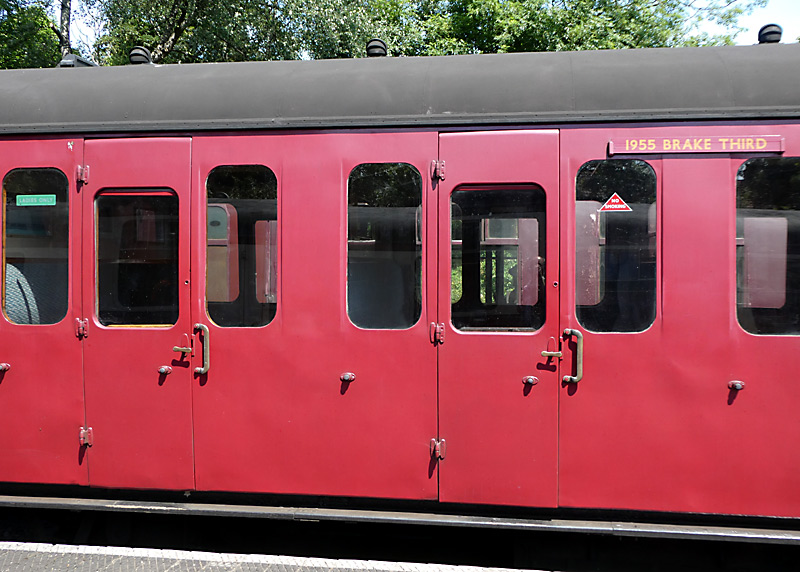
The compartment on the left is reserved for Ladies Only, this was a safety measure - ladies who felt vulnerable were encouraged to travel as close as possible to a member of staff (the guard)
The compartment on the right has a 'no smoking' sign - all trains had a mix of seating areas where smoking was and was not allowed and whilst many passengers respected this there were a few who did not care about other passengers and smoked where it was not allowed. Often these miscreants would also physically attack anyone who asked them to refrain from smoking in that part of the train.
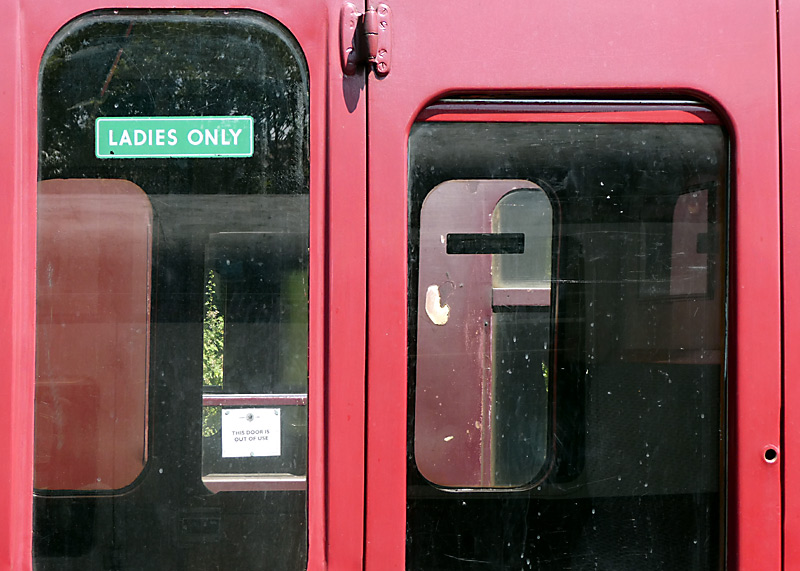
The Ladies Only sign on the compartment window glass.
This photograph dates from my 2018 visit, the sign was not seen during my 2022 visit.
http://www.cs.rhrp.org.uk/se/CarriageInfo.asp?Ref=1933
Mk1 Compartment Carriages Intended For Longer Distance Trunk Routes
Nowadays InterCity blue grey livery No.W16237 resides at the Epping - Ongar Railway. This railway has brought to life most of a former single track rural branch line that through a quirk of history became part of the London Underground railway system and for several decades was served by small profile tube trains.
The EOR is located close to Epping station on the London Underground Central Line. The visitor experience includes free travel on a vintage London bus between Epping station and
the EOR's station at North Weald.
The EOR website is at http://eorailway.co.uk/ .

British Railways Mk1 composite compartment (CK) carriage No.W16237 in InterCity blue grey livery.
There are four first class compartments which seat 24 passengers and three standard class compartments which seat either 18 or 24 passengers. Possibly the standard class seating would have been designated as third class, however the latter was abolished in 1956.
http://www.cs.rhrp.org.uk/se/CarriageInfo.asp?Ref=2919

A first class compartment inside No.W16237.
Even if the armrests were folded up this compartment would still only be suitable for three aside seating. Other features include posher looking additional reading lamps and that for greater comfort each passenger has their own seat cushion.

Inside No.W16237 standard class compartment, with interior sprung bench style seating.
The lack of armrests is because CK coaches built for the Southern and Western regions were of a higher capacity design with four-a side seating. CK carriages for the other regions had folding arms that when lowered reduced their seating capacity by one passenger per bench seat (from four to three passengers). Folding arms are seen in a different CK carriage below.

Also travelled on at the NNR is No. E25189. Built in 1957 this second corridor (SK) coach is upholstered in a fabric design that was also used on many other types of train - including the full third and the buffet carriages seen elsewhere on this page. http://www.cs.rhrp.org.uk/se/CarriageInfo.asp?Ref=1725

Note the three recesses on the left side of the window frame. These are for the window sun blind (which is not present at this location). They allow the blind to be partially lowered. The stud just below the window frame is for when the blind is fully lowered.
This image also shows part of a ledge-type table (below the window) and just to its left is an ash tray.
The preserved multiple-unit train (seen below) includes a view of a lowered window blind and how the window recesses are replicated on both sides of the window.

Three aside second class compartment in British Railways Mk1 brake corridor composite compartment (BCK) carriage M21027.
The arm rests fold up in a way which converts the seating to bench type, making it possible for four passengers to be seated there.
Folding up the armrests would have also made it easier for passengers to reach the window seats.

A first class compartment in the same carriage.
Hmm, garish upholstery - and definitely three aside seating, even when the armrests have been folded up!
This carriage is at the East Anglian Railway Museum (EARM). http://www.cs.rhrp.org.uk/se/CarriageInfo.asp?Ref=1655

Composite carriages have a door in the corridor designed to leave passengers in no doubt about the class status of that part of the train and therefore reduce the likelihood of them accidentally (but not purposely!) travelling in the wrong part of the train.
Composite carriages have a door in the corridor designed to leave passengers in no doubt about the class status of that part of the train and therefore reduce the likelihood of them accidentally (but not purposely!) travelling in the wrong part of the train.

Above and below:
Individual reading lights, heater controls, a full luggage rack and traditional brocade style upholstery!
Despite the bench type seating not having armrests this compartment is definitely for passengers travelling first class.
This is known because by looking at the larger version of the image below it is possible to see the same upholstery as in the
view inside the compartment plus a 'First' sign on the compartment door. In addition, the image numbers are sequential!

Looking along the corridor it is possible to see where there would have been a door
between the second - or third - class compartments and the first class compartments.

This is believed to be the passenger carriage seen above - a Western Region liveried Mk1 brake composite corridor coach (BCK) at the front of the train / next to the Class 90 electric locomotive. The compartment configuration looks correct (three first, three standard / second / third), the image numerical sequence is correct and it was typical for me to explore the entire train! Alas, the carriage number is not readable.

BSK (Brake Second Corridor) carriage No. M35469 (built in 1963) in crimson lake and cream livery at the front of a train about to embark on a leisure-market day-trip. To the right of the image can be seen part of the locomotive which hauled the train (EWS liveried 90 018).
The railways usually placed 'brake' vehicles (which have handbrakes) at train ends as a safety measure in case a coupling failed and the train became divided - especially on a gradient. Whilst the normal braking system would stop the separated portion of the train, there was a concern that over time the effectiveness of the brakes might wear off, so a handbrake was seen as the best way to be sure that the carriages did not start to roll downhill.
This image shows the carriage information which details things such as its physical dimensions, the lines over which it is allowed to travel (route restriction), the carriage type, its maximum permitted speed, when it last had a major service / inspection, the train braking and heating systems with which it is compatible... http://www.cs.rhrp.org.uk/se/CarriageInfo.asp?Ref=1923
Mk1 Open Carriages Intended For Longer Distance Trunk Routes
Originally Mk1 vehicles featured a timber veneer interior finish, however this later changed to a laminate finish.

British Railways Mk1 Tourist Second Open (TSO) built 1953 carriage No.E3779 at the East Anglia Railway Museum. http://www.cs.rhrp.org.uk/se/CarriageInfo.asp?Ref=1254

Another view of the same carriage - as the door is open it is possible to go inside.

The wooden veneer and comfortable seating inside No.E3779.

Even the tables comprise polished wood.

British Railways Mk1 SO (second open) carriage No.4809 which was built in 1957 and has 1+2 style of seating.
This is now owned by the Epping Ongar Railway. http://www.cs.rhrp.org.uk/se/CarriageInfo.asp?Ref=2757

British Railways Mk1 TSO (tourist second open) carriage (number unknown) with 2+2 bench type seating which is now used on leisure services which travel on the mainline railway network.
Common Features

A close-up view of the heating controls found in many Mk1 passenger carriage compartments.

The top of a Mk1 carriage door - this is from a carriage which is still used on the mainline railway network, albeit on leisure services.
Most of the signage is modern, however the warning not to lean out of the window is possibly an original historic feature.
The top of the window has a sprung metal clip which engages in slots on either side of the window opening.
Nowadays secondary door locks are a legal requirement as it lessons the chance of the doors being opened at the wrong time (eg: whilst the train is in motion) which sometimes resulted in passengers falling out. This could happen because sometimes the door would not be closed properly before station departure. Another reason for these extra locks is to reduce the likelihood of passengers opening the door (and potentially hitting a passenger standing on the platform) before the train has stopped when arriving at a station. The on-board train staff are supposed to close the locks immediately before station departure and supervise their opening when arriving at stations.

The bottom of a Mk1 carriage door - the opening window 'droplights' are supported by a spring-loaded lazytongs mechanism inside the lower part of the door.

It serves no purpose explaining where these toilet compartment views were taken.

This view shows how the frosted windows allow light to enter, although there is also electric lighting which is needed at night and when travelling through tunnels. This light is over the hand basin, the ceiling lighting was not photographed.

Inside the same toilet compartment showing the hand basin. This view comes from a carriage which is still in active service and in addition to the no smoking sign (which possibly is required by law) the present owner has decided to fit a liquid soap dispenser. It is more likely that in olden days there would have been a soap tablet which would be there for all passengers to use.

A different carriage, a different style of hand basin. The blue disc on the cold water tap is missing.

Outside two toilet compartments. These are located at one end of the carriage / next to (station platform) entrance doors.
As this carriage has two toilets they are located on opposite sides of the carriage.
Walking past the toilets leads to the corridor connection to the next carriage.

What was called the communication cord. Pulling this stopped the train. To discourage passengers from doing this a fine would be levied if it was used when there was not an emergency situation that required the train to make an unscheduled stop.
Also note the sign about the opening window. The reason for this is that the windows featured an external aerofoil so that when partially open passengers could benefit from draught-free ventilation.

One of the windows which if only opened a little will create ventilation but not a draught.
In this view the window is seen fully open, so it did create a draught, albeit only when the train was travelling between stations.

Some living museums run trains which include preserved buffet carriages where passengers can buy light refreshments. Many passengers on the mainline railways might have preferred that when these buffet carriages were withdrawn they had been replaced with new ones offering similar facilities!
Preserved Multiple-Unit Mk1 Train
Formerly known as the Metropolitan Heritage Train but nowadays called The London Transport Museum (LTM) Heritage Train this comprises an ex-British Railways Class 438 4TC (trailer control) multiple-unit fixed formation set of four carriages. At each end of the train is a DTSO / driving trailer second open carriage. Between them is TFK / trailer first corridor and TBSK / trailer brake second corridor.
Travelling in the compartments of the two side-corridor carriages is especially nostalgic, and first class is especially comfortable! This mix of compartment and open style seating means that only some of the passengers are able to sample what it is like to travel in a compartment. Everyone else must travel in the open carriages. Nevertheless, even for these passengers the ride experience (a comment that includes seat comfort) is still far better than most present-day trains!
Originally these Mk1 carriages were locomotive-hauled, they were converted to multiple-unit format by BR at York Works in two batches in 1966-1967 and 1974. In this format they were primarily used on services between London Waterloo, Bournemouth and Weymouth. Between London and Bournemouth they operated in push-pull mode with a high power (3200 HP) Class 430 4-REP four carriage electric multiple-unit attached at the London end of the train, whilst over the non-electrified line between Bournemouth and Weymouth they would operate in push-pull mode with a Class 33/1 diesel locomotive at the Weymouth end of the train (and without the 4REP units).
Sometimes motive traction also came from a Class 73 electro-diesel locomotive - these are electric locomotives which also have a diesel engine which is used when away from the electrified third rail network.
Operating in 'push-pull' mode means that sometimes the traction unit pulled the train from the front and at other times it pushed the train from the back. The train driver however was always at the front of the train. For these service the drivers used the 4TC cabs at the front of the train when travelling from London to Bournemouth and when travelling from Weymouth to Bournemouth. In opposite directions the train was driven from the cabs in either the 4REP unit (Bournemouth - London) or the diesel locomotive (Bournemouth - Weymouth).
Although sometimes used at living museums the LTM Heritage Train is also used during special events on suburban parts of the London Underground system, which is very much a working railway (ie: one that carries fare paying passengers). during which time it travels at something nearer to normal speed rather than the very slow 25 mph (40 km/h) speed limit which most heritage railways must observe.
| BR Number | Year Built | Previous Carriage Type Code | Previous Full Name | Year Converted | New Carriage Type Code | New Full Name | LT Number |
| 3938 | 1955 | TSO | Tourist Second Open | 1966 | DSOT | Driving Standard Open Trailer | 76297 |
| 4009 | 1957 | TSO | Tourist Second Open | 1966 | DSOT | Driving Standard Open Trailer | 76324 |
| 13097 | 1954 | FK | First Corridor | 1974 | TFK | Trailer Trailer Corridor | 71163 |
| 34970 | 1957 | BSK | Brake Second Corridor | 1966 | TBSK | Trailer Brake Standard Corridor | 70823 |
Regarding the carriage codes, the letter T designated a coach with Tourist seating, which is 2 + 2 arranged in groups of four, sometimes with a table. (Coaches without the letter T had 2 + 1 seating). However this was only when hauled by a locomotive. When used as part of a multiple unit train the letter T in the carriage code signifies an unpowered trailer coach.
The images of this train primarily show the passenger seating - and not all four coaches. Therefore the links to other web pages with further information have been added below:
Driving standard open trailer LT 76297 http://www.cs.rhrp.org.uk/se/CarriageInfo.asp?Ref=4478
Driving standard open LT 76324 http://www.cs.rhrp.org.uk/se/CarriageInfo.asp?Ref=4488
Trailer corridor first LT 71163 http://www.cs.rhrp.org.uk/se/CarriageInfo.asp?Ref=4478
Trailer brake second corridor LT 70823 http://www.cs.rhrp.org.uk/se/CarriageInfo.asp?Ref=4481
Page at Wikipedia with further information about these trains: http://en.wikipedia.org/wiki/British_Rail_Class_438

A side view of the trailer brake standard corridor (TBSK) coach showing the imitation wood vinyl wrap, the guards area (with an open door), an empty compartment and that in its guise as the Metropolitan Heritage Train this train wore the Metropolitan Railway coat of arms.
The three ochre coloured metal bars across the window are there to prevent passengers from sticking their heads out and looking along the side of the train. This is done for safety reasons.

The side corridor plus some of the compartments can be seen through the window and open doorway.

The driving cab end of driving trailer standard open (DTSO) carriage No. 76324 and view of a seating bay through an open door.
Also seen here is something that was a common feature of varnished teak carriages, this being that there were often variations in shade (hue, colour depth) between the wooden panels which formed the carriage sides. This was because they come from a natural product of different ages.
2017 Refurbishment
In 2017 this train was repainted into London Transport livery and equipped with an electronic central door locking system.
This train has never actually worn this livery in the past, but the general public are unlikely to care that it is more pastiche than accurately depicting real history. A completely different way of looking at things suggests that the new livery is actually helping create a new future history of a train that survived long enough to have a second life! If one thinks of things in this way then it will not matter that the electronic central door locking system required visible changes to every passenger door in the form of new metal plates being added to the lower portion of the doors and electromagnets being fitted to the footboards below the doors.
Fitting a central door locking system means that it is no longer possible to open the doors when the train is travelling between stations - nor when the still-moving train is slowing down to stop at a station / departing from a station - these being being potentially dangerous actions which some passengers performed when these 'slam door' trains were in daily public service.

A side view of the trailer brake standard corridor (TBSK) coach after the 2017 changes (upgrade???).
Despite reflections from bright sunlight it is possible to peer through the compartment on the left and see someone walking along the side corridor. A plastic water bottle and some coffee cups can be seen on the small window ledge table of the compartment on the right.
The door for the guards area is still open! (left edge of the image) and on the lower section of the passenger door can be seen the new metal plate and that the look of the footboard has also been altered by the fitting of electromagnets for the new central door locking system. Also new is a light between the two compartment windows (near the top) which illuminates when the passenger doors are unlocked.
The photographs below show the inside seating, etc., of the London Transport Museum (LTM) Heritage Train. More information about this train and a collection of photographs showing it carrying passengers can be found on
the web page about London Underground's Vintage & Heritage Trains. This is the link to that page.

Inside a compartment - the reading lights suggest that this may have originally been built for first class passengers but was later downgraded to standard class. This sometimes happened on the railways - if it suited the management!
Although similar to the view seen earlier on this page everything in this image looks cleaner!
Note the window frame recesses on both sides of the window and the partially lowered window blind.

Standing with my back to the outside window, looking towards the side corridor.
Both window blinds are fully raised and my photograph just clipped the top of the ventilator and heating controls.

Seated with my back to the side corridor, looking towards and through the outside window.
Note the small table which is just large enough for a few drinks.
Dating from the London 2012 Olympic and Paralympic games the advertisement seen through the window is also of nostalgic interest.

Inside an open carriage with 2 + 2 facing seating around tables and correctly aligned to the windows.
All the carriages in this train still retain their original filament (incandescent) light bulb lighting.
The carriages with open seating also have lights over the table - these are located in gaps in the luggage racks.

Seating bay with window and table.

Not all seating bays have tables. Others have doors - as seen here. The window is almost fully open.

Inside a first class compartment which was originally used by passengers who liked to smoke tobacco whilst they travelled - the window stickers banning smoking would not have been there in those days. An ashtray can be seen to the left of the window ledge table; to the right of the table can be seen some screw holes which suggest that originally there would have also been an ashtray at that position.

A closer view of an ashtray - this is located next to the seats at the corridor end of the compartment.

The luggage area in the trailer brake standard corridor (TBSK) coach - most of the security mesh fence has been removed.
Not easily seen is that wire mesh protects the lights above the goods area..
In the distance is the guards' compartment and beyond that some compartment type seating for passengers plus the side corrdor.
 A film which comprises a medley of Southern Region Mk1 electric multiple unit trains, both at stations and when riding inside,
has been placed on the ‘YouTube’ film / video website and can either be watched above or in a new window by clicking this link:
http://www.youtube.com/watch?v=EvShrS9_Guk
Direct links to other related pages (with small images)...
- Metropolitan Railway Electric Locomotive No.12 'Sarah Siddons'
- Compartment Seating On British Trains
- London Underground's Vintage & Heritage Trains
Click letterbox  if you wish to send me an email.
This page represents a branchline off the main website so after viewing it should be closed - however in case you arrived here courtesy of a search engine then this link will take you to the Albums pages index http://citytransport.info/Album.htm and this link http://citytransport.info will take to you the opening page of this website.
Click letterbox if you wish to send me an email.
This page last updated 14th November 2023 (with apologies for previously publishing a partially incomplete updated version of this page)
E & OE.
© Copyright 2001 - 2026 Simon P Smiler and named image sources.
Privacy Policy.
